Your business is growing. You've crossed AED 200,000 in annual turnover, but you're still below the mandatory VAT registration threshold of AED 375,000. Your accountant mentioned voluntary VAT registration 2026, but you're not sure if it's worth the compliance burden.
Here's what most SMEs in the UAE miss: if you're spending on business expenses like rent, inventory, marketing, or equipment, you're paying VAT on those costs. With VAT audit activity increasing and thresholds unchanged at AED 375,000 for mandatory and AED 187,500 for voluntary registration, SMEs now need to treat VAT decisions as part of their financial strategy, not just a compliance tick‑box.But without VAT registration, you can't recover that input VAT. That's money leaving your business every month that could be coming back to you.
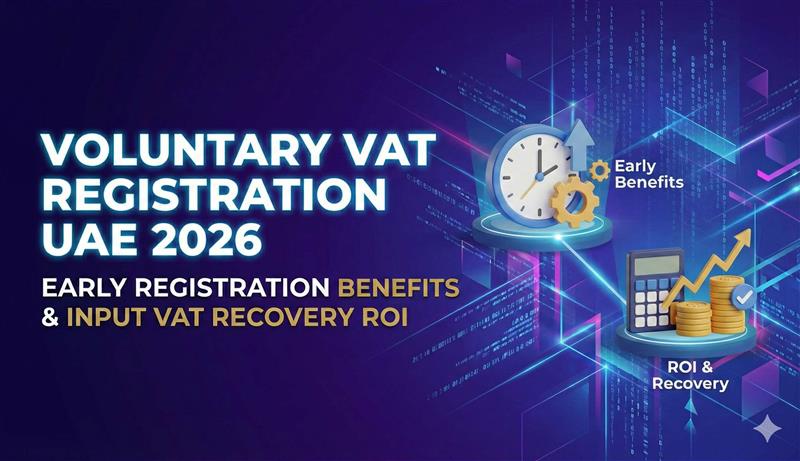
For SMEs with turnover between AED 187,500 and AED 374,999, voluntary VAT registration isn't just about compliance. It's a financial decision that can improve cash flow, reduce costs, and give you a competitive advantage over businesses that wait until they're forced to register.
➤ What Is Voluntary VAT Registration UAE?
In the UAE, businesses must register for VAT if their taxable supplies exceed AED 375,000 in the last 12 months or are expected to exceed this threshold in the next 30 days. This is mandatory registration.
But the FTA also allows businesses to register voluntarily if their taxable supplies or taxable expenses exceed AED 187,500 in a 12‑month period.
Once you register, you become a tax-registered business. You must charge VAT on your sales, file VAT returns every quarter, and maintain proper records. But in return, you can recover the VAT you pay on business expenses.
For many SMEs, this trade-off is worth it because the input VAT recovery outweighs the compliance cost.
➤ Who Should Consider Voluntary VAT Registration?
Voluntary VAT registration makes sense for businesses in specific situations:
- You have high operating costs. If you're spending heavily on rent, inventory, marketing, equipment, or professional services, you're paying VAT on these expenses. Registration lets you recover this input VAT every quarter.
- You sell to VAT-registered businesses. If your customers are already VAT-registered, they can recover the VAT you charge them. This means your pricing remains competitive, and you get the benefit of input VAT recovery.
- You want to position yourself as a credible supplier. Many corporate buyers and government entities prefer working with VAT-registered suppliers. Registration signals that your business is established, compliant, and professional.
- You're planning to scale quickly. If you expect to cross the mandatory threshold soon, registering early gives you time to set up systems, train your team, and avoid the rush of last-minute compliance.
➤ The ROI of Input VAT Recovery
Here's a simple example to show how input VAT recovery works:
Your business has AED 250,000 in annual turnover. You spend AED 120,000 per year on rent, inventory, software, and marketing. At 5% VAT, you're paying AED 6,000 in input VAT on these expenses.
If you're not VAT-registered, you absorb this AED 6,000 as a cost. But if you register voluntarily, you can recover it through your VAT returns.
Now let's say you charge 5% VAT on your sales. At AED 250,000 turnover, you collect AED 12,500 in output VAT from customers. You pay AED 6,000 in input VAT on expenses. Your net VAT liability to FTA is AED 6,500.
But here's the key: that AED 6,000 you recovered is cash that would have been lost if you stayed unregistered. Over three years, that's AED 18,000 back in your business.
Input VAT can only be recovered when you are VAT‑registered and when conditions such as holding a valid tax invoice and intending to pay the supplier within the allowed timeframe are met, so timing your registration matters.
For SMEs operating on tight margins, this cash flow boost can fund growth, cover operational costs, or reduce reliance on credit.
➤ When Voluntary VAT Registration Doesn't Make Sense
Voluntary registration isn't right for every business. Here are situations where you should wait:
- You sell mainly to end consumers. If your customers are individuals who can't recover VAT, adding 5% to your prices may hurt your competitiveness. In this case, staying unregistered keeps your pricing lower.
- Your expenses are low or VAT-exempt. If most of your costs are salaries, non-VAT expenses, or exempt supplies like residential rent, you won't recover much input VAT. The compliance burden may outweigh the benefit.
- You're not ready for compliance. VAT registration requires proper bookkeeping, quarterly filings, and audit-ready records. If your business doesn't have these systems in place, rushing into registration can create stress and penalties.
- If you register but then miss filings, under‑report VAT or keep weak records, the cost of penalties and assessments can quickly outweigh the benefit of early input VAT recovery, especially as the FTA tightens enforcement and uses data analytics to target high‑risk sectors.
➤ How to Register for Voluntary VAT in UAE
The process for voluntary VAT registration 2026 is straightforward:
- Confirm your taxable supplies exceed AED 187,500 in the last 12 months.
- Prepare your trade license, financials, and business bank statements.
- Submit your application through the FTA portal.
- Wait for FTA approval (typically around 20 business days, depending on completeness and any additional evidence requested).
- Once approved, set up your invoicing, accounting, and VAT filing systems.
After registration, you must file VAT returns every quarter, even if your VAT liability is zero. Missing a VAT return deadline can result in penalties of AED 1,000 for the first late filing and AED 2,000 for repeated late filings within 24 months, so compliance is critical.
➤ Competitive Advantage of Early Registration
Beyond the financial benefit, voluntary VAT registration gives SMEs a competitive edge in the UAE market.
Corporate credibility. Many large companies and government entities only work with VAT-registered suppliers. Registration opens doors to contracts and opportunities that aren't available to unregistered businesses.
Better pricing negotiations. When your customers can recover the VAT you charge, your pricing becomes more competitive against larger, registered competitors.
Audit readiness. VAT registration forces you to maintain proper records, audit trails, and compliance systems. This prepares your business for growth, external audits, and future funding rounds.
➤ How ASC Global Helps with Voluntary VAT Registration
At ASC Global, we help SMEs across the UAE assess whether voluntary VAT registration 2026 makes sense for their business. Our services include:
VAT registration ROI analysis. We calculate your input VAT recovery potential and compare it to the compliance cost, so you can make an informed decision.
FTA registration support. We handle the entire registration process, from document preparation to FTA submission and follow-up.
Bookkeeping and VAT filing. After registration, we manage your quarterly VAT returns, reconciliation, and compliance reporting so you can focus on running your business.
Audit-ready systems. We set up proper invoicing, record-keeping, and audit trails to ensure you're always ready for FTA reviews.
➤ Frequently Asked Questions
Q1. What is the voluntary VAT registration threshold in UAE?
A1. The voluntary VAT registration threshold is AED 187,500 in annual taxable supplies or taxable expenses. If your business exceeds this amount but stays below the mandatory threshold of AED 375,000, you can choose to register and start recovering input VAT.
Q2. Can I deregister from VAT if my turnover drops?
A2. Yes, but only if your turnover falls below AED 187,500 for 12 consecutive months. You must apply to FTA for deregistration, and they will review your case.
Q3. How long does voluntary VAT registration take?
A3. FTA typically processes voluntary VAT registration applications within 20 business days. However, this can vary depending on the completeness of your application.
Q4. Is there a penalty for late VAT registration?
A4. Yes. If your taxable supplies exceed AED 375,000 and you fail to register within the required timeframe, the FTA can impose a late registration penalty of AED 10,000. Voluntary registration before you hit the mandatory threshold helps you avoid both this risk and the rush of last‑minute compliance.
Q5. Can I recover input VAT from before my registration date?
A5. No. You can only recover input VAT on expenses incurred after your VAT registration effective date. This is why early registration can maximize your recovery over time.
➤ Conclusion
For SMEs with turnover between AED 187,500 and AED 374,999, voluntary VAT registration 2026 is a strategic decision that goes beyond compliance. It's about improving cash flow, reducing costs, and positioning your business for growth.
The key is to assess your input VAT recovery potential, understand the compliance requirements, and register when the financial benefit outweighs the administrative burden.
With new VAT enforcement trends and time limits on using VAT credits, SMEs that delay registration may miss out on recoverable VAT and face more intense scrutiny when they eventually register.
Get Expert Voluntary VAT Registration & Input VAT Recovery Support Today
📞 Call: +971503287722
💬 WhatsApp: https://wa.me/971503287722
🌐 Visit: www.ascglobal.ae
📩 Email: info@ascglobal.ae
ASC Global UAE — your trusted partner for VAT registration strategy, input VAT recovery, FTA compliance, and audit-ready tax structuring.
 Risk Advisory
 Tech & Cyber Security
 Merger & Acquisition
 Due Diligence
 Business Advisory
 Business Setup & PRO
 Corporate Tax Advisory
 Accounting & Assurance
 VAT Advisory