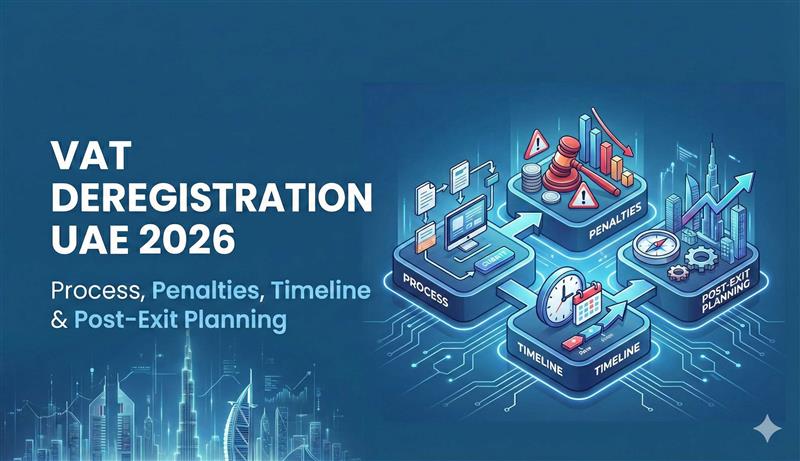
You've made the difficult decision to close your business, restructure operations, or downsize significantly. Your trade license is being cancelled, suppliers are being paid off, and employees have received their end-of-service benefits. But there's one critical compliance step most business owners overlook: VAT deregistration.
Failing to properly deregister from VAT with the FTA can result in penalties, ongoing compliance obligations, and audit risks that continue long after you've closed your doors. Recent enforcement trends show the FTA using deregistration reviews and post‑exit audits to check whether final returns, deemed supplies, and record‑keeping obligations were correctly handled. Even if your business is no longer trading, the FTA expects you to file returns, maintain records, and formally exit the VAT system.
For business owners exiting operations or companies restructuring in the UAE, understanding the VAT deregistration 2026 process is essential to avoid unnecessary costs and ensure a clean exit.
This blog will walk you through the FTA deregistration process, timelines, penalties, and post-exit planning to ensure your VAT obligations end when your business does.
VAT deregistration is the formal process of cancelling your VAT registration with the FTA. Once deregistered, you are no longer required to charge VAT on sales, file VAT returns, or maintain VAT records.
Deregistration is required or may be requested in the following situations:
If any of these apply to you, you must apply for FTA deregistration UAE within the required timeline. Failure to do so can result in penalties and ongoing compliance obligations.
The FTA has strict rules about when you must deregister:
Business closure or cessation of taxable activities: You must apply for deregistration within 20 business days of ceasing taxable supplies. The 20‑business‑day deadline runs from the date you became no longer eligible to be registered, not from the date you “remember” to inform the FTA, so documenting your cessation date is critical. This includes situations where you've closed your business, cancelled your trade license, or stopped all commercial activity.
Turnover below voluntary threshold: If your turnover falls below AED 187,500 for 12 consecutive months, you can apply for voluntary deregistration. This is optional, but many businesses choose to deregister to avoid compliance costs.
Trade license cancellation: If your trade license is cancelled or expired, you must deregister for VAT immediately. The FTA will not accept the excuse that you forgot or assumed deregistration happens automatically.
Here's the step-by-step process for deregistering from VAT in the UAE:
Step 1: Confirm Eligibility and Stop Charging VAT
Confirm that you meet the conditions for deregistration (business closure, structure change, or falling below thresholds) before you stop charging VAT; the effective date will be set by the FTA based on your application. Once you've decided to deregister, stop charging VAT on any new supplies. You can only charge VAT until your effective deregistration date, which is set by the FTA.
Step 2: Settle Outstanding VAT Liabilities
Pay any outstanding VAT owed to the FTA. This includes VAT from your last filed return and any penalties or interest.
Step 3: Submit Deregistration Application
Log in to the FTA portal and submit your deregistration application. You'll need to provide:
Step 4: File Your Final VAT Return
The FTA will set an effective deregistration date and typically processes complete deregistration applications within about 20 business days, although this can be longer if they request additional information or conduct checks.You must file a final VAT return covering the period from your last return up to the deregistration date.
Your final return must include:
Step 5: Pay or Reclaim Final VAT Balance
If your final return shows a liability, you must pay it before deregistration is approved. If you have a refund due, the FTA will process it after reviewing your final return.
Step 6: Receive Deregistration Confirmation
Once the FTA approves your application and verifies your final return, you'll receive official deregistration confirmation. Keep this document for your records.
One of the most overlooked aspects of VAT cancellation is deemed supply. When you deregister, the FTA treats any remaining stock, assets, or inventory as if you've sold them. You must account for output VAT on these items in your final return.
For example, if you have AED 50,000 worth of inventory when you deregister, you must calculate 5% VAT (AED 2,500) and include it in your final return as output VAT. This is true even if you haven't actually sold the stock.
Many business owners are caught off guard by this requirement and face unexpected VAT liabilities at deregistration.
The FTA imposes strict penalties for late or incorrect deregistration:
Late deregistration application: AED 1,000 for the first month of delay and AED 1,000 for each additional month, capped at AED 10,000, if you fail to apply within 20 business days of becoming eligible.
Late final VAT return: Administrative penalties apply for late filing and late payment of the final return, starting from AED 1,000 for the first late filing and increasing for repeated delays.
Unpaid VAT liabilities: The FTA will not approve your deregistration until all VAT liabilities, penalties, and interest are paid in full.
Incorrect final return: Filing an incorrect or incomplete final return can trigger fixed penalties (for example AED 3,000 for a first offence and AED 5,000 for repeats), plus potential percentage‑based penalties if tax is under‑declared.
These penalties can add up quickly, especially if your business is already facing cash flow challenges during closure or restructuring.
Even after deregistration, you have ongoing obligations:
Record retention: You must keep all VAT records, invoices, and supporting documents for at least 5 years from the end of the tax period to which they relate, even after deregistration, and longer for certain assets such as real estate.
Final audit risk: The FTA may conduct a post-deregistration audit to verify your final return and ensure all VAT was correctly accounted for.
Future reregistration: If you restart business activities in the UAE, you may need to register for VAT again. Keep your deregistration documents as proof of proper exit.
Not applying on time. Many business owners assume deregistration happens automatically when they cancel their trade license. It doesn't. You must apply separately.
Ignoring deemed supply. Failing to account for output VAT on remaining stock and assets is one of the most common errors.
Filing incomplete final returns. Your final return must include all transactions up to the deregistration date. Missing invoices or expenses can trigger audits.
Assuming penalties are waived. The FTA does not waive penalties for business closures. You must pay all liabilities before deregistration is approved.
At ASC Global, we help business owners and companies exiting operations complete the VAT deregistration 2026 process smoothly and compliantly.
Deregistration application support: We handle the entire FTA application process, including document preparation and submission.
Final VAT return preparation: We prepare and file your final return, including deemed supply calculations and reconciliation.
Penalty mitigation: We help resolve outstanding VAT liabilities, negotiate with FTA where possible, and minimize penalties.
Post-exit compliance: We ensure your records are audit-ready and stored properly for FTA retention requirements.
Q1. How long does VAT deregistration take in UAE?
The FTA typically processes VAT deregistration within about 20 business days from the date a complete application is submitted, but the timeline can be longer if there are outstanding liabilities or if the FTA requests additional documents or verifications.
Q2. Can I deregister if I still have outstanding VAT?
No. The FTA will not approve your deregistration until all VAT liabilities, penalties, and interest are paid in full.
Q3. What happens to my VAT refunds after deregistration?
If your final return shows a refund due, the FTA will process it after reviewing your return. This can take several weeks.
Q4. Do I need to file VAT returns after my trade license is cancelled?
This is because VAT deregistration is a separate process from licence cancellation and only takes effect once the FTA approves your application and issues confirmation in EmaraTax.
Q5. What is deemed supply and how is it calculated?
Deemed supply is the VAT you must pay on remaining stock and assets when you deregister. It's calculated as 5% of the market value of those items.
For business owners exiting operations or restructuring in the UAE, proper VAT deregistration is not optional. It's a legal requirement that, if ignored, can result in penalties, audits, and ongoing compliance obligations long after your business has closed.
Understanding the VAT deregistration 2026 process, timelines, and post-exit obligations ensures you exit cleanly and avoid unnecessary costs.
📞 Call: +971503287722
💬 WhatsApp: https://wa.me/971503287722
🌐 Visit: www.ascglobal.ae
📩 Email: info@ascglobal.ae
🚀 Exit cleanly and compliantly — let ASC Global handle your VAT deregistration today.
Need more information on VAT Deregistration UAE 2026: Process, Penalties, Timeline & Post‑Exit Planning?
 VAT Advisory
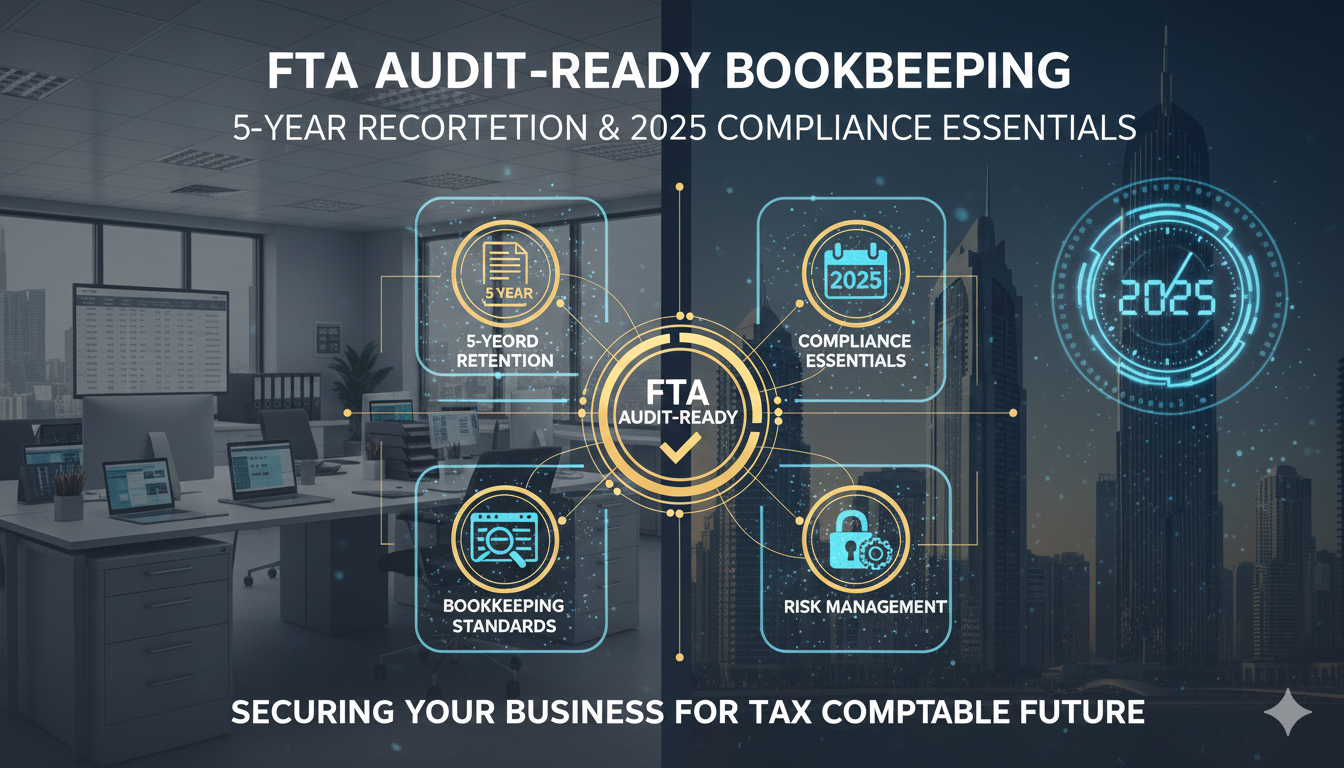
➤ Introduction – Why FTA Bookkeeping Requirements UAE Matter in 2025 2025 marks a turning point for tax compliance in...
Read More
Office 04 - 1803, 18th floor, One by Omniyat Business bay, Dubai
302-18 Edgecliff Golfway, North York, Toronto, Ontario M3C 3A3
Via F.lli Gabba 3, 20121 – Milan, Italy
RM2106, Huishangsha Edifice, No.37, Baoshi West RD, Shiyan Town, Bao’an District, Shenzhen - 518108, China
C-100, Sector 2, Noida (UP), Delhi NCR, India 201301
One Raffles Place, Tower 1, 27-03 Singapore - 048616
 Merger & Acquisition
 Due Diligence
 Business Advisory
 Business Setup & PRO
 Corporate Tax Advisory
 Accounting & Assurance
 Risk Advisory
 Tech & Cyber Security
 VAT Advisory