For many UAE businesses, VAT return filing is treated as a routine task. In 2026, this approach is creating serious compliance problems.
The authorities are tightening controls around VAT return deadlines, data consistency, and transaction reporting, especially as the UAE moves closer to mandatory e-invoicing frameworks. Businesses that file late, submit incorrect figures, or rely on incomplete records are facing escalating penalties, blocked refunds, and audit notices.
With fixed fines, compounding late‑payment charges, and error‑based penalties that can reach up to 300% of unpaid VAT, even small mistakes repeated over time now carry significant financial impact.
Whether your company files monthly or quarterly VAT returns, accuracy and timing are no longer negotiable. An error-free VAT return in 2026 requires disciplined record-keeping, correct tax treatment, and clear understanding of current UAE VAT requirements.
This guide explains VAT return filing in 2026, key deadlines, penalty risks, common mistakes, and how UAE businesses can stay compliant.
All VAT-registered businesses in the UAE must file VAT returns through the Federal Tax Authority portal, even if there is no VAT payable.
VAT return filing applies to:
There are no exemptions based on company size or turnover once registered.
The FTA confirms the exact due date for each tax period in your EmaraTax account, so you must check the portal regularly rather than assuming generic dates.
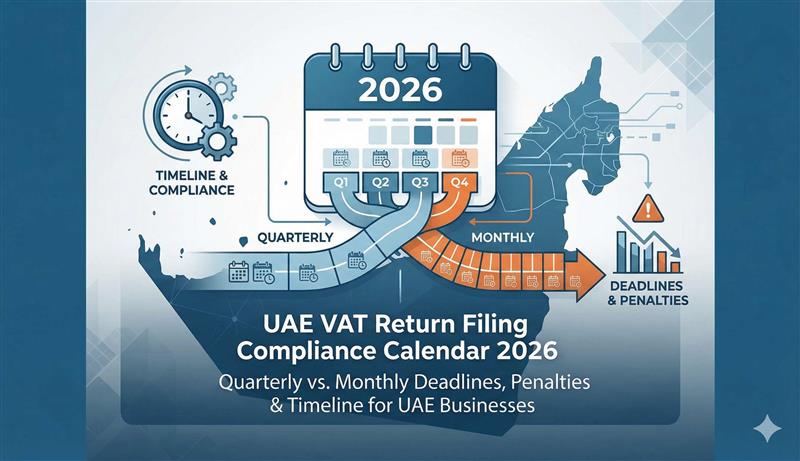
Most SMEs are on a quarterly VAT return cycle, while larger businesses or high-risk entities may be assigned monthly filing.
The 28‑day deadline and penalty structure are the same for monthly and quarterly filers, so filing less often does not reduce penalty exposure or audit risk.
Missing the deadline, even by one day, triggers penalties automatically.
While full e-invoicing rollout is being phased, 2026 is a transition year for VAT compliance.
From 1 July 2026, e‑invoicing will be available on a voluntary or pilot basis for many VAT‑registered businesses ahead of phased mandatory adoption from 2027, so aligning returns to invoice‑level data now is critical.
Businesses that fail to prepare their invoicing systems and processes are more likely to file inaccurate VAT returns, even if filings are on time.
1. Late VAT Return Submission
Late filing triggers penalties regardless of intent or cash-flow issues.
2. Incorrect VAT Classification
Misreporting standard-rated, zero-rated, or exempt supplies is a frequent issue.
3. Input VAT Claimed Without Proper Documents
Missing or invalid tax invoices can lead to disallowed input VAT.
4. Errors in Reverse Charge Mechanism
Many UAE businesses misreport imports and overseas services.
5. Rushed Filings Without Review
Last-minute submissions increase the risk of errors and future audits.
VAT penalties in 2026 are structured to discourage repeat non-compliance.
For businesses filing regularly, small errors repeated over multiple periods can quickly turn into large liabilities.
Improper VAT return filing affects more than just penalties.
In 2026, VAT compliance is closely linked with broader financial and regulatory reviews.
ASC Global helps UAE businesses maintain accurate, timely, and audit-ready VAT compliance.
Our approach focuses on accuracy, consistency, and risk reduction, not rushed filings.
Q1. What is the VAT return deadline in the UAE?
A1. VAT returns must be filed within 28 days from the end of the tax period, and any VAT due must also be paid by that date. If the deadline falls on a weekend or public holiday, it moves to the next working day.
Q2. Do I need to file a VAT return if there is no VAT payable?
A2. Yes. Nil VAT returns must still be filed on time.
Q3. What happens if I file my VAT return late?
A3. Late filing triggers a fixed penalty of AED 1,000 for the first late return and AED 2,000 if repeated within 24 months, plus separate late‑payment penalties of 2% immediately and 4% per month on any unpaid VAT, up to 300% of the tax due.
Q4. Is e-invoicing mandatory for VAT returns in 2026?
A4. E-invoicing is being phased in, but VAT data accuracy is already under scrutiny.
Q5. Can VAT penalties be reduced?
A5. In some cases, penalty reconsideration may be possible with proper justification.
Q6. Does quarterly VAT return filing reduce compliance risk?
A6. No. Quarterly filings still carry full penalty exposure if incorrect or late.
VAT return filing in 2026 is no longer a simple reporting task. With stricter monitoring, rising penalties, and growing alignment with invoice-level data, UAE businesses must treat VAT compliance as a core financial responsibility.
Filing on time is not enough. Accuracy, documentation, and consistency are now essential to avoid penalties and audits. Professional VAT support helps businesses stay compliant, reduce risk, and focus on operations with confidence.
Get Expert VAT Return Filing & Compliance Support Today
📞 Call: +971503287722
💬 WhatsApp: https://wa.me/971503287722
🌐 Visit: www.ascglobal.ae
📩 Email: info@ascglobal.ae
Let’s ensure your VAT return filing in 2026 is accurate, compliant, and penalty-free with ASC Global.
Need more information on Error-Free VAT Return Filing 2026: Master Deadlines, E-Invoicing & Penalty Escalation?
 VAT Advisory
➤ Introduction – Why FTA Bookkeeping Requirements UAE Matter in 2025 2025 marks a turning point for tax compliance in...
Read More
Office 04 - 1803, 18th floor, One by Omniyat Business bay, Dubai
302-18 Edgecliff Golfway, North York, Toronto, Ontario M3C 3A3
Via F.lli Gabba 3, 20121 – Milan, Italy
RM2106, Huishangsha Edifice, No.37, Baoshi West RD, Shiyan Town, Bao’an District, Shenzhen - 518108, China
C-100, Sector 2, Noida (UP), Delhi NCR, India 201301
One Raffles Place, Tower 1, 27-03 Singapore - 048616
 Merger & Acquisition
 Due Diligence
 Business Advisory
 Business Setup & PRO
 Corporate Tax Advisory
 Accounting & Assurance
 Risk Advisory
 Tech & Cyber Security
 VAT Advisory