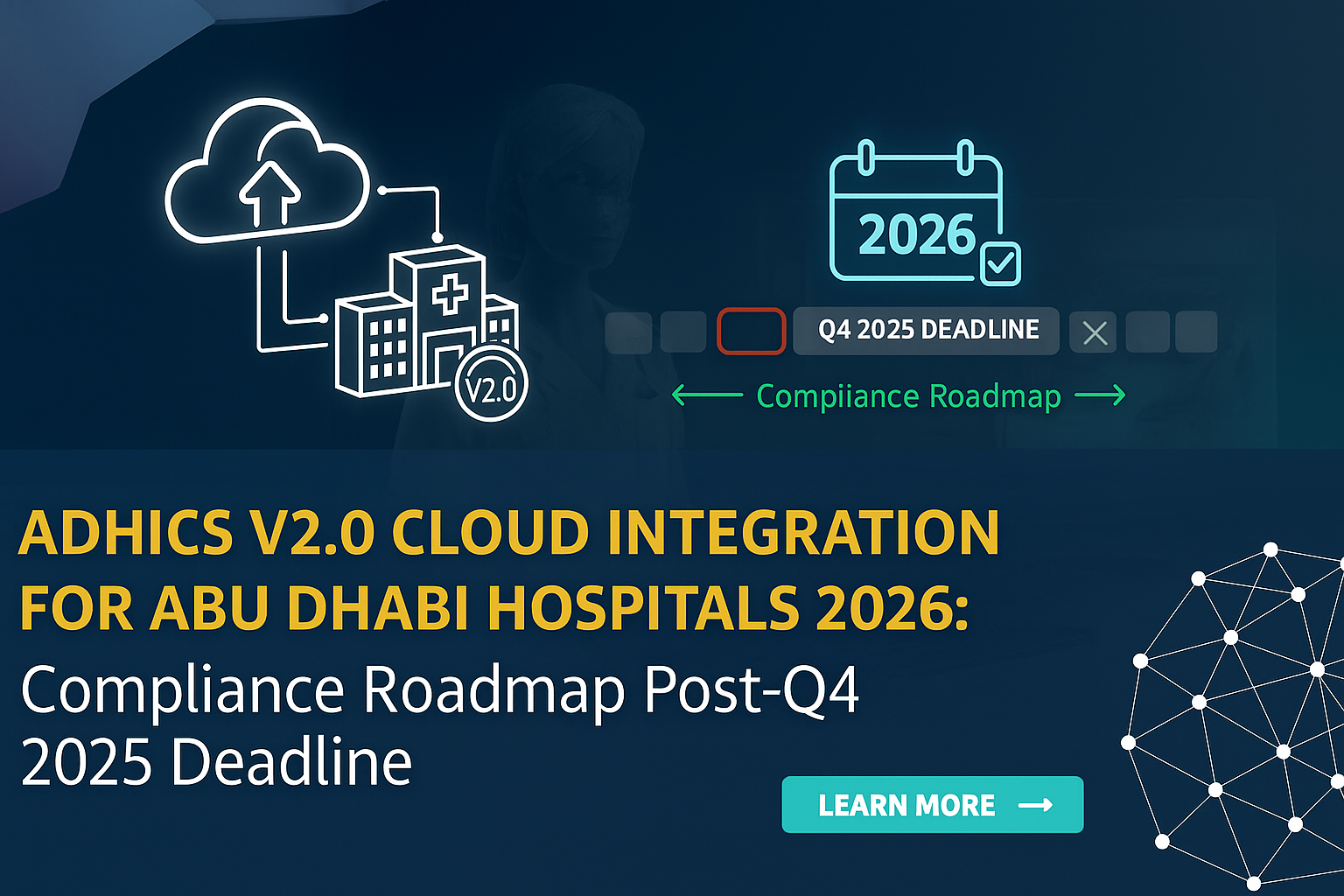
Abu Dhabi hospitals that missed the Q4 2025 ADHICS v2.0 compliance deadline now need to accelerate their shift to fully compliant, UAE-hosted cloud environments before 2026 – or risk regulatory delays, corrective actions, and stalled digital transformation projects. The most effective way forward is a structured compliance roadmap aligned with ADHICS v2.0 cloud, cybersecurity, and PHI governance requirements.
ADHICS (Abu Dhabi Healthcare Information and Cyber Security Standard) v2.0 introduces stricter expectations around Zero Trust security, encryption governance, UAE data residency, identity and access control, and PHI lifecycle assurance. As hospitals scale digital health, telemedicine, AI diagnostics, and cloud-based HIS/EMR platforms, pressure to meet ADHICS v2.0 has intensified. With DoH Abu Dhabi increasing inspections and cross-border data checks through 2025–2026, cloud compliance is no longer optional – it is foundational to operational approval.
The direction is clear: only hospitals with verifiable, ADHICS-aligned cloud controls will remain compliant and operationally approved in 2026; cloud adoption without governance now creates more risk than benefit
ADHICS v2.0 requires UAE hospitals to enforce UAE data residency, Zero-Trust security, full encryption, PHI lifecycle management, and vendor compliance validation across all cloud-hosted clinical systems.
Hospitals should start by identifying which cloud workloads, PHI flows, and vendors are not aligned with ADHICS v2.0 controls.
Example:
A telehealth setup may find diagnostic images or backups stored in non-UAE regions; migrating those workloads to a UAE-sovereign cloud restores alignment with ADHICS data localization requirements.
Answer-First: Build a UAE-sovereign, Zero-Trust architecture supporting secure PHI operations.
Answer-First: Apply ADHICS controls without clinical downtime.
Case Example:
A 250-bed Abu Dhabi facility reduced cyber risk by 78% after restructuring IAM, isolating PACS workloads, and integrating Sentinel/GD monitoring.
Answer-First: Prepare complete ADHICS documentation for DoH auditors.
| ADHICS Requirement | Mandate | UAE Cloud Capabilities (Azure / AWS / G42) | |
| UAE Data Residency | PHI must remain in UAE | UAE Central / UAE Regions | |
| Encryption | AES-256 + HSM | Azure Key Vault / AWS KMS / G42 HSM | |
| Monitoring | Real-time SIEM | Azure Sentinel / AWS GuardDuty | |
| Identity | MFA + PAM | Azure Entra / IAM Identity Center | |
| Network | Zero-Trust | VPC + PrivateLink |
No. Hybrid models are allowed, provided PHI is handled according to ADHICS controls and UAE data residency requirements.
For PHI workloads, this generally conflicts with ADHICS data localization unless specific approvals and safeguards are in place.
Yes. Hospitals remain accountable and should obtain evidence that each PHI-handling vendor supports ADHICS and UAE data residency obligations.
Depending on size and complexity, many providers complete ADHICS-aligned cloud remediation in a matter of weeks to a few months when following a structured roadmap.
UAE-hosted deployments on Azure, AWS, and G42 Cloud are commonly used because they provide sovereign regions, encryption, identity, and monitoring capabilities that can be aligned to ADHICS.
ADHICS v2.0 cloud compliance is now a critical operational requirement for Abu Dhabi hospitals, especially those that missed the Q4 2025 deadline. With DoH tightening inspections, enforcing UAE data-residency mandates, and scrutinizing PHI governance more closely, hospitals cannot continue operating legacy or non-compliant cloud environments. A structured, evidence-based compliance roadmap—covering gap assessment, UAE-sovereign architecture design, cloud hardening, and audit documentation—offers the fastest and safest path to full alignment.
Hospitals that modernize their cloud infrastructure in line with ADHICS v2.0 not only reduce cyber risk but also accelerate digital health transformation, telemedicine readiness, and AI-enabled clinical services. In short, ADHICS compliance is not just a regulatory obligation—it is now the foundation for secure, scalable, and future-ready healthcare operations in Abu Dhabi.
ASC Global UAE helps hospitals design and implement ADHICS v2.0–aligned cloud strategies, from PHI mapping and gap assessments to architecture design, remediation, and audit support.
ASC Global UAE delivers:
✅ ADHICS v2.0 Compliance Roadmaps
✅ Cloud Architecture Alignment (Azure UAE / AWS UAE / G42)
✅ PHI Mapping, Gap Assessments & Corrective Actions
✅ Regulator-Ready Documentation for DoH Abu Dhabi
✅ Ongoing Cloud Security Monitoring & Audit Support
Contact ASC Global UAE Today:
📞 Call: +971503287722
💬 WhatsApp: https://wa.me/971503287722
🌐 Visit: www.ascglobal.ae
📩 Email: info@ascglobal.ae
Book a FREE 30‑minute ADHICS Cloud Readiness Consultation – confidential, no obligation, and tailored for UAE healthcare providers.
Need more information on ADHICS v2.0 Cloud Integration for Abu Dhabi Hospitals 2026: Compliance Roadmap Post-Q4 2025 Deadline?
 Tech & Cyber Security
Your company just signed off on a multi-million dirham ERP system. The vendor promised better visibility, faster reporti...
Read More
Office 04 - 1803, 18th floor, One by Omniyat Business bay, Dubai
302-18 Edgecliff Golfway, North York, Toronto, Ontario M3C 3A3
Via F.lli Gabba 3, 20121 – Milan, Italy
RM2106, Huishangsha Edifice, No.37, Baoshi West RD, Shiyan Town, Bao’an District, Shenzhen - 518108, China
C-100, Sector 2, Noida (UP), Delhi NCR, India 201301
One Raffles Place, Tower 1, 27-03 Singapore - 048616
 Merger & Acquisition
 Due Diligence
 Business Advisory
 Business Setup & PRO
 Corporate Tax Advisory
 Accounting & Assurance
 Risk Advisory
 Tech & Cyber Security
 VAT Advisory