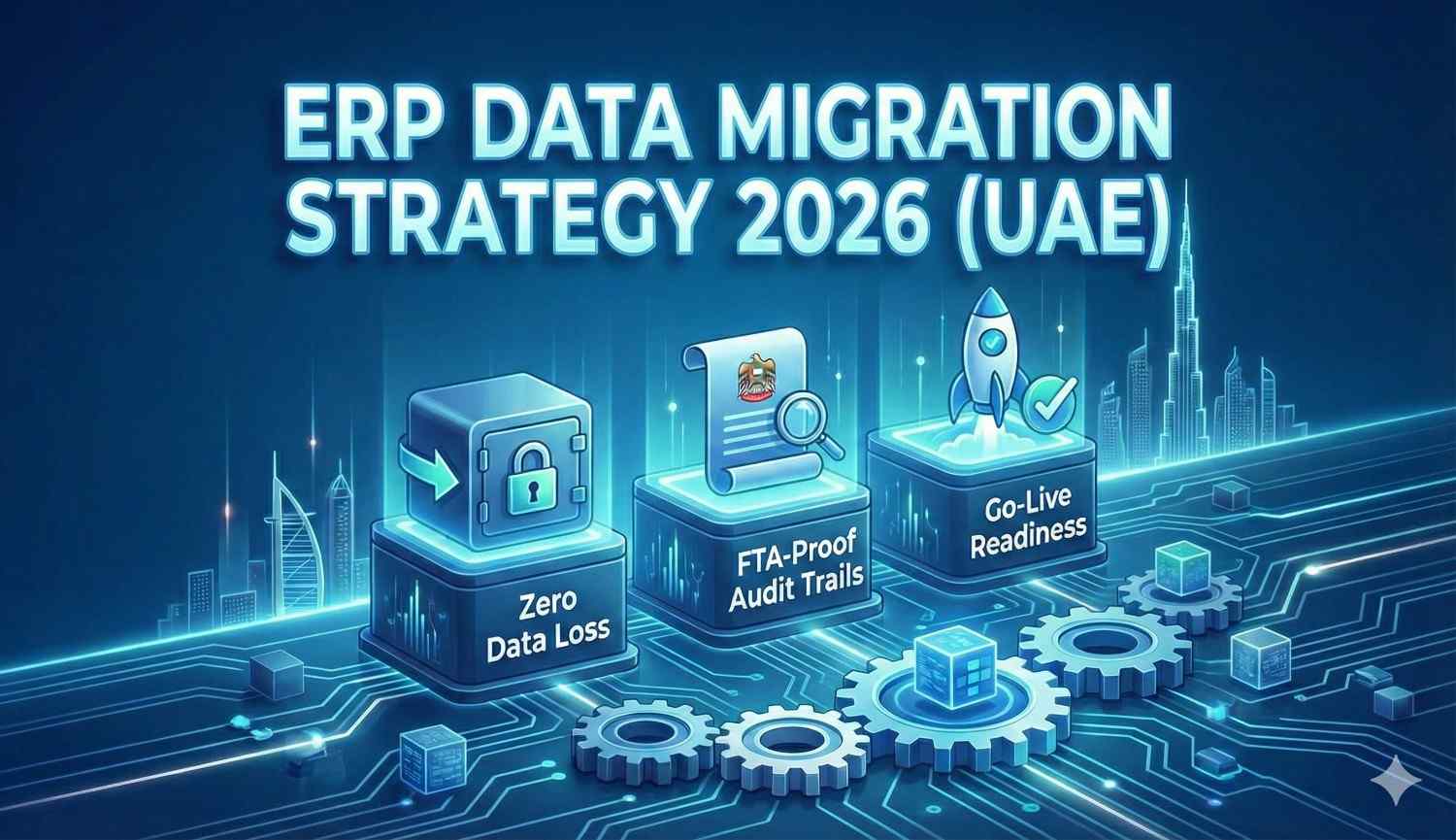
Your company just signed off on a multi-million dirham ERP system. The vendor promised better visibility, faster reporting, and full compliance with UAE Corporate Tax and VAT. But six months into the project, your finance team is stuck reconciling legacy data. With stricter VAT audit expectations, 9% Corporate Tax, and upcoming e‑invoicing, an ERP that is not data‑clean and compliance‑mapped is now a direct FTA risk, not just an operational headache. Your IT director is firefighting integration issues. And your auditor just flagged gaps in your VAT trail that could trigger FTA penalties.
This is the reality of ERP implementation 2026 UAE failure — not because the software is bad, but because businesses underestimate the complexity of data migration, compliance mapping, and go-live readiness in the UAE regulatory environment.
If you're a CFO, IT director, or procurement lead at a UAE manufacturer, retailer, finance firm, or logistics company, this blog will show you how to avoid costly mistakes and ensure your ERP go-live is smooth, compliant, and audit-ready.
ERP projects fail for three main reasons in the UAE:
Poor data migration planning. Companies move millions of rows of transactional data without cleaning, mapping, or validating it first, which breaks VAT trails and opening balances needed for audits.
Weak compliance mapping. UAE businesses must align ERP data with FTA VAT and Corporate Tax rules, or risk wrong VAT box mapping and misclassified income and expenses.
Rushed go-live timelines. When systems go live without proper testing and parallel runs, finance cannot easily produce transaction‑level data, ledgers, and reconciliations on demand during an FTA review.
ERP data migration UAE is the process of moving your financial, operational, and transactional data from legacy systems into your new ERP platform. This includes customer and supplier records, chart of accounts, open invoices, inventory records, historical VAT returns, and Corporate Tax filings.
The challenge is not just moving the data. It's ensuring the data is accurate, complete, and structured to meet UAE compliance requirements.
For example, your VAT returns must tie back to every invoice in your ERP. Your Corporate Tax filings must reflect true income and expenses, supported by audit trails. If your migration doesn't preserve this integrity, you're setting yourself up for compliance failures.
Your ERP must also retain invoice‑level and tax records for at least 5 years for VAT (and longer for capital assets and real estate), in a format that can be quickly retrieved during FTA audits.
Many companies migrate data "as is" without cleaning it first. This means duplicate customer records, incorrect VAT codes, and outdated pricing all move into the new system.
Your legacy system may not have fields for UAE-specific tax treatments like zero-rated exports, exempt supplies, or reverse charge VAT. If you don't map these correctly in your new ERP, your VAT returns will be wrong from day one.
Your chart of accounts is the backbone of financial reporting. If it's not designed to support Corporate Tax classifications, ESR reporting, and VAT reconciliation, your finance team will struggle to close books and file accurate returns.
Some businesses skip the parallel run phase, where the old and new systems run side by side for validation. Without testing, you won't catch errors until after go-live, when it's too late.
A successful ERP go-live requires a structured approach:
Pre-Migration Phase
Migration Phase
Go-Live Phase
Post-Go-Live Phase
ERP compliance mapping means ensuring your ERP system can generate accurate, audit-ready reports for FTA and Ministry of Finance requirements.
VAT Compliance
Corporate Tax Readiness
Audit Trail Requirements
A failed ERP implementation doesn't just disrupt operations. It creates compliance risks that can trigger FTA audits and penalties.
Missing VAT Trail: If your ERP migration doesn't preserve invoice-level VAT data, you won't be able to reconcile your VAT returns. FTA can demand supporting documents for every return filed. If you can't produce them, you face penalties and interest.
Incorrect Corporate Tax Filings: Corporate Tax returns require accurate classification of revenue and expenses. If your chart of accounts is wrong, or if data migration introduced errors, your tax filings will be incorrect.
Audit Exposure: FTA audits focus on data integrity, audit trails, and compliance documentation. If your ERP system can't produce clean, complete reports, you'll fail the audit.
At ASC Global, we work with CFOs, IT directors, and finance teams across UAE manufacturing, retail, finance, and logistics sectors to ensure ERP implementations are compliant, accurate, and audit-ready.
Pre-Implementation Advisory: We design your chart of accounts and data model to be FTA‑ready before any ERP customisation starts, so VAT and Corporate Tax reporting work from day one.
Data Migration Support: We target zero data loss by cleansing, mapping, and reconciling historical VAT and Corporate Tax data so opening balances and audit trails are intact.
Compliance Mapping: We configure ERP fields and reports so VAT returns, Corporate Tax schedules, ESR, and AML reports can be generated directly from your system with minimal manual intervention.
Go-Live Testing: We conduct parallel runs, reconciliation checks, and user acceptance testing to catch errors before your system goes live.
Post-Go-Live Support: After go-live, we provide ongoing support to monitor system performance, resolve issues, and prepare for your first FTA filings under the new system.
Q1. What is the biggest risk in ERP data migration for UAE businesses?
A1. The biggest risk is migrating inaccurate or incomplete data. If your VAT codes, chart of accounts, or transaction history is wrong, your ERP will generate incorrect reports and expose you to FTA penalties.
Q2. How long should a parallel run last before ERP go-live?
A2. A parallel run should last at least one full accounting cycle, typically one month. This gives your team time to validate data, test workflows, and identify issues before switching off the old system.
Q3. Can my ERP system handle UAE Corporate Tax and VAT requirements?
A3. Not all ERP systems are built for UAE compliance. You need to ensure your system supports correct tax codes, reverse charge VAT, transfer pricing documentation, and audit trail requirements.
Q4. What happens if my ERP goes live with errors?
A4. Errors discovered after go-live can disrupt operations, delay financial reporting, and create compliance risks. You may need to reverse transactions, reprocess invoices, or file amended VAT returns.
Q5. Do I need external support for ERP data migration?
A5. If your team lacks experience with UAE tax and compliance requirements, external support is critical. ASC Global brings accounting, tax, and audit expertise to ensure your ERP migration is compliant and audit-ready.
Q6. How do I know if my ERP is audit-ready?
A6. Your ERP is audit-ready if it can produce complete transaction histories, reconcile VAT returns to the general ledger, support Corporate Tax classifications, and retain documents per UAE legal requirements.
ERP implementation 2026 UAE failure is not inevitable. With the right data migration strategy, compliance mapping, and go-live readiness plan, your business can avoid costly mistakes and ensure a smooth transition to your new system.
The key is to start early, involve compliance experts, and test thoroughly before go-live. Your ERP is not just a software upgrade. It's the foundation of your financial reporting, tax compliance, and audit readiness for years to come.
📞 Call: +971503287722
💬 WhatsApp: https://wa.me/971503287722
🌐 Visit: www.ascglobal.ae
📩 Email: info@ascglobal.ae
🚀 If you’re planning an ERP in 2026 or trying to rescue a troubled implementation, ASC Global can step in at any phase—from chart of accounts design and data migration reviews to FTA audit‑readiness testing—so your next FTA visit is routine, not a crisis.
Need more information on ERP Data Migration Strategy 2026 (UAE): Zero Data Loss, FTA‑Proof Audit Trails & Go‑Live Readiness?
 Tech & Cyber Security
➤ IntroductionHealthcare providers in Abu Dhabi operate within one of the most structured regulatory environments in the...
Read More
Office 04 - 1803, 18th floor, One by Omniyat Business bay, Dubai
302-18 Edgecliff Golfway, North York, Toronto, Ontario M3C 3A3
Via F.lli Gabba 3, 20121 – Milan, Italy
RM2106, Huishangsha Edifice, No.37, Baoshi West RD, Shiyan Town, Bao’an District, Shenzhen - 518108, China
C-100, Sector 2, Noida (UP), Delhi NCR, India 201301
One Raffles Place, Tower 1, 27-03 Singapore - 048616
 Merger & Acquisition
 Due Diligence
 Business Advisory
 Business Setup & PRO
 Corporate Tax Advisory
 Accounting & Assurance
 Risk Advisory
 Tech & Cyber Security
 VAT Advisory