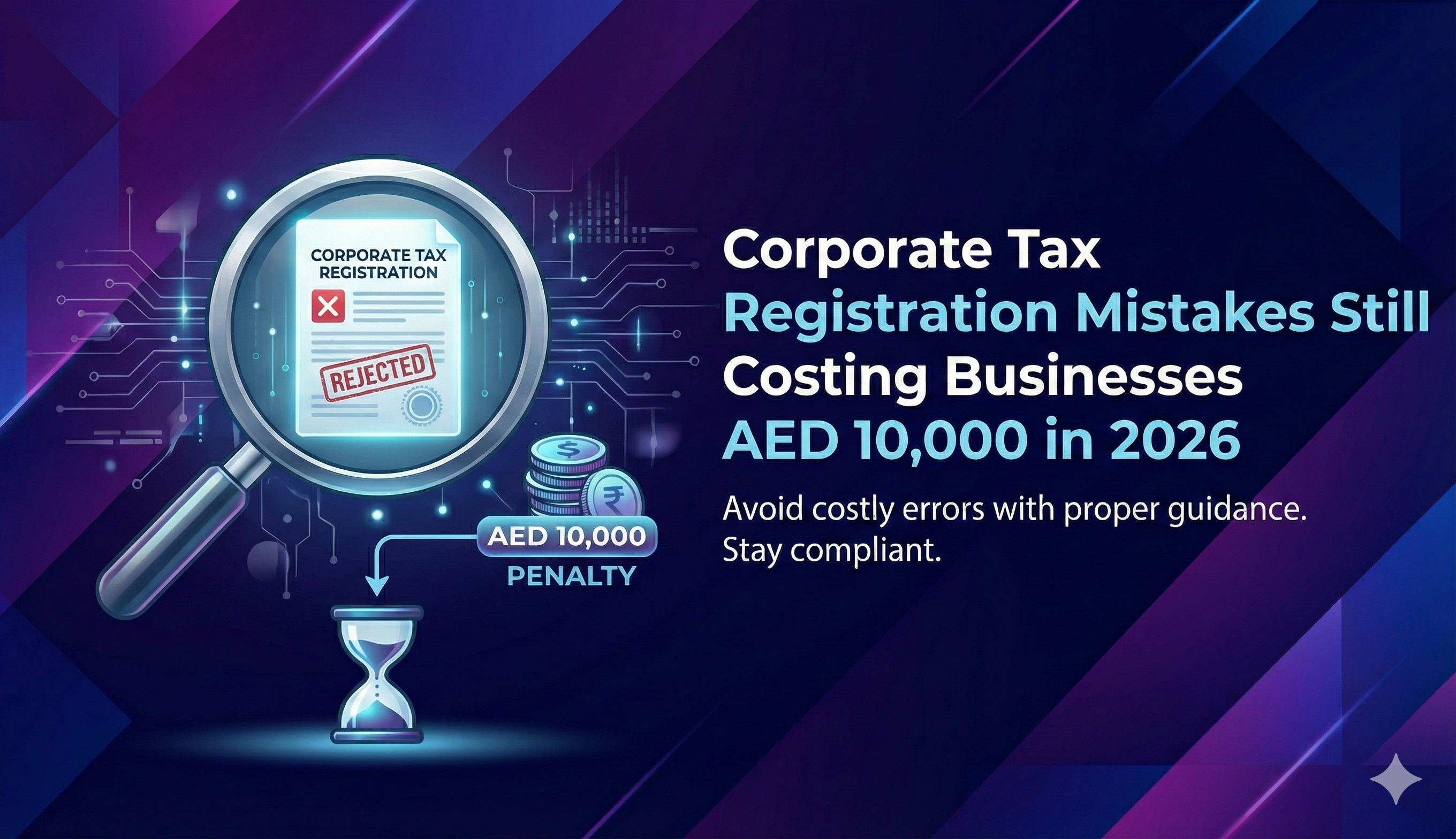
Despite two full years of corporate tax awareness campaigns, the AED 10,000 corporate tax penalty remains one of the most avoidable financial exposures facing UAE companies in 2026. Under current Cabinet Decisions, failing to submit a UAE corporate tax registration application within the FTA’s prescribed timelines triggers an administrative penalty of AED 10,000 per taxable person. What makes this concerning is not the amount — but the pattern. Most penalties are not triggered by aggressive tax positions. They stem from misjudging registration obligations.
In 2026, the Federal Tax Authority (FTA) is no longer educating. It is enforcing.
The UAE’s corporate tax regime has moved beyond introductory compliance. Enforcement systems are now more structured, data-driven, and automated.
Several developments are shaping the current environment:
Registration is no longer treated as a procedural formality. It is now a compliance marker. Businesses that fail to register within prescribed timelines are flagged quickly.
For many SMEs and free zone entities, the assumption that “we’ll register later” is proving costly.
Rather than simple “mistakes,” most penalties arise from what can be described as misjudgment zones.
Many businesses misinterpret revenue thresholds — particularly those experiencing fluctuating turnover. Some assume that if taxable profit is low, registration can be deferred. However, registration obligation is not solely profit-driven. Misreading eligibility timelines has resulted in delayed applications.
Holding companies and subsidiaries often assume that group-wide oversight is sufficient. In practice, each entity’s registration status must be assessed independently unless formally structured under specific relief provisions.
Companies with limited activity frequently assume they are exempt. However, an active trade license combined with revenue-generating transactions — even minimal — may trigger registration requirements.
Qualifying Free Zone Persons (QFZPs) may benefit from 0% corporate tax on qualifying income. But 0% does not mean “no registration.” The misconception that tax benefits eliminate compliance obligations has been a repeated trigger for AED 10,000 fines.
Finance teams handling VAT and corporate tax separately sometimes fail to align revenue tracking with registration deadlines. This internal disconnect can delay recognition of eligibility thresholds.
The headline penalty is visible. The indirect consequences are not.
Late registration flags may surface during external audits or investor due diligence.
Financial institutions increasingly assess regulatory standing during facility renewals.
Corporate tax registration data is being compared with VAT filings. Inconsistencies can prompt broader reviews.
Mergers, acquisitions, and restructuring exercises require clean compliance records. Penalties complicate negotiations.
The true cost of late corporate tax registration in 2026 is operational friction.
In some periods the FTA has offered limited penalty waiver initiatives for late corporate tax registration, but these are time‑bound and conditional, and businesses should not rely on them as a strategy.
Rather than reacting to penalty notices, forward-thinking businesses are implementing structured internal reviews. A professional compliance reset should follow a framework approach:
Assess every licensed entity under the group. Do not assume uniform applicability.
Align accounting systems to trigger alerts when revenue thresholds approach registration triggers.
Ensure trade licenses, ownership structures, and financial records align with FTA submission requirements.
Engage a corporate tax advisor to validate timelines and prevent interpretation gaps.
This approach shifts compliance from reactive correction to preventive governance.
The UAE corporate tax regime has entered a mature enforcement phase. Registration compliance is now foundational — not optional, not procedural, and not deferrable.
Businesses that treat registration as an administrative afterthought risk avoidable exposure in a regulatory environment that is increasingly data-integrated and enforcement-ready.
In 2026, corporate tax registration is not about paying tax. It is about demonstrating regulatory discipline.
Q1. What is the penalty for late corporate tax registration in the UAE?
A1. The FTA imposes an AED 10,000 administrative penalty for failing to register for corporate tax within prescribed timelines. This fine applies regardless of whether tax is ultimately payable.
Q2. Do Free Zone companies need to register for UAE corporate tax?
A2. Yes. Every free zone company, including Qualifying Free Zone Persons benefiting from a 0% rate on qualifying income, must register for corporate tax with the FTA and obtain a Tax Registration Number (TRN).
Q3. How can businesses avoid the AED 10,000 corporate tax penalty?
A3. By monitoring revenue thresholds closely, mapping registration deadlines for each entity, aligning VAT and corporate tax data, and seeking professional advisory validation before those deadlines are breached.
If your business has not formally reviewed its corporate tax registration status in 2026, now is the time. A structured eligibility assessment today can prevent avoidable fines tomorrow.
ASC Global’s corporate tax specialists help UAE mainland and free zone companies validate registration timelines, assess threshold exposure, and secure full compliance with FTA requirements — before penalties are triggered.
Speak to our Corporate Tax Advisory team today:
📞 Call: +971503287722
💬 WhatsApp: https://wa.me/971503287722
🌐 Visit: ascglobal.ae/our-services/corporate-tax-advisory
📩 Email: info@ascglobal.ae
Protect your business from unnecessary AED 10,000 penalties with proactive advisory support.
Need more information on Corporate Tax Registration Mistakes Still Costing Businesses AED 10,000 in 2026?
 Corporate Tax Advisory
Here's an uncomfortable question worth asking your finance team today: has your business actually registered for UAE Cor...
Read More
Office 04 - 1803, 18th floor, One by Omniyat Business bay, Dubai
302-18 Edgecliff Golfway, North York, Toronto, Ontario M3C 3A3
Via F.lli Gabba 3, 20121 – Milan, Italy
RM2106, Huishangsha Edifice, No.37, Baoshi West RD, Shiyan Town, Bao’an District, Shenzhen - 518108, China
C-100, Sector 2, Noida (UP), Delhi NCR, India 201301
One Raffles Place, Tower 1, 27-03 Singapore - 048616
 Merger & Acquisition
 Due Diligence
 Business Advisory
 Business Setup & PRO
 Corporate Tax Advisory
 Accounting & Assurance
 Risk Advisory
 Tech & Cyber Security
 VAT Advisory