Sharjah Airport International Free Zone (SAIF Zone) provides company formation opportunities for businesses involved in trading, manufacturing, logistics, warehousing and professional services. Its location near Sharjah International Airport makes it relevant to companies involved in international trade and distribution. Investors can establish an eligible business by selecting the appropriate licence, choosing a legal structure, arranging suitable facilities and completing the registration requirements. The setup timeline depends on the business activity, documentation and authority approvals.
ASC Global assists investors and organisations with evaluating SAIF Zone licensing options, preparing registration documents and coordinating company formation formalities.
Why Choose SAIF Zone for Business Setup?
SAIF Zone offers a business environment designed to support trading, industrial and service-oriented companies. Its facilities and licensing options can accommodate different operational requirements.
Airport connectivity: Its location near Sharjah International Airport can be useful for businesses involved in air cargo, international distribution and time-sensitive shipments.
Trading opportunities: Importers, exporters and distributors can explore commercial licensing for approved product categories.
Industrial facilities: Manufacturing and processing businesses can assess industrial licences, warehouses and land options.
Warehousing solutions: Companies requiring storage, packaging and distribution facilities can evaluate the available warehouse arrangements.
Business structures: Investors can explore single-shareholder and multi-shareholder company structures as well as eligible branch registration.
Office choices: Different office arrangements are available for businesses with varying workspace and staffing needs.
However, SAIF Zone may not be the right choice for every business. Companies focused on specialised professional services or activities that do not require its industrial and logistics infrastructure should compare other licensing options before deciding.
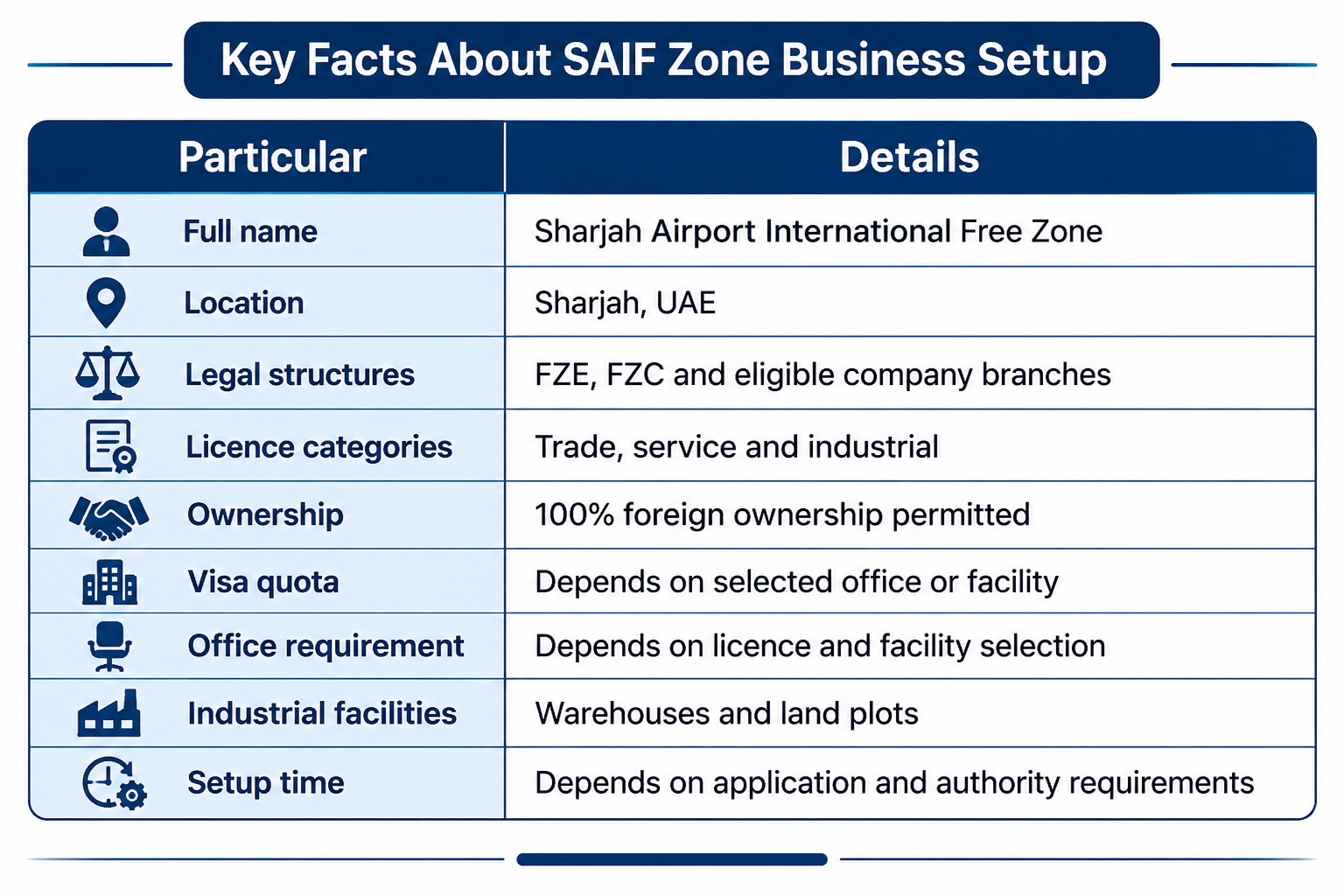
SAIF Zone's official business setup information identifies three principal licence categories: trade, service and industrial. It also provides different facility arrangements depending on the nature of the business.
Allowed Business Activities
The permitted activities depend on the selected licence and the authority's approved activity list.
Trading activities: A trade licence can cover the import, export, distribution, consolidation, storage and warehousing of approved products. The official SAIF Zone description specifies a maximum of three similar product lines under this licence category.
Service activities: Businesses offering eligible professional and commercial services can explore service licensing. Examples published by SAIF Zone include business consultancy, shipping, freight forwarding and e-commerce.
Industrial activities: Companies involved in manufacturing, processing, assembling, packaging and exporting finished products can assess industrial licensing options.
Warehousing and logistics: Businesses requiring storage and distribution facilities can evaluate suitable warehouse arrangements.
Jewellery manufacturing: Investors involved in jewellery production can explore the specialised facilities available within the zone.
Certain industrial activities require clearance from the relevant SAIF Zone Health and Environment Department. Additional regulatory permissions may apply depending on the proposed products and operations.
Cost and Fee Overview
The total cost of establishing a company in SAIF Zone depends on the licence category, legal structure, selected facility and visa requirements.
Potential expenses include:
-
Company registration charges.
-
Trade licence issuance and renewal.
-
Business activity charges.
-
Office or executive office rental.
-
Warehouse rental.
-
Industrial land rental.
-
Establishment card and immigration charges.
-
Employee and investor visa expenses.
-
External approvals and technical documentation.
The authority offers different office arrangements with published visa allocations:
-
SAIF Suite: Eight visa quota.
-
SAIF Executive Office: Five visa quota.
-
SAIF Office: Three visa quota.
These figures are published facility-specific allocations, not a universal visa entitlement. Actual eligibility and availability should be confirmed with the authority.
Industrial businesses should also consider utilities, facility preparation, equipment installation and other operational costs.
SAIF Zone's official website should be consulted for a current quotation because a single price cannot represent every licence and facility combination.
Step-by-Step SAIF Zone Business Setup Process
Step 1: Identify your business requirements
Determine whether the company will undertake trading, manufacturing, logistics, warehousing or service activities.
Step 2: Select the licence category
Choose the appropriate trade, service or industrial licence according to the proposed business operations.
Step 3: Select the legal structure
Evaluate whether an FZE, FZC or eligible branch registration is appropriate for the ownership arrangement.
Step 4: Choose the business name
Prepare proposed company names and submit them for approval according to SAIF Zone requirements.
Step 5: Select an appropriate facility
Evaluate the available office, executive office, warehouse or industrial land options. Consider the number of employees and expected operational requirements.
Step 6: Prepare the application documents
Collect shareholder information, company documents, business activity descriptions and other supporting paperwork.
Step 7: Submit the application
Submit the application through the authorised registration process and respond to any additional document requests.
Step 8: Obtain approvals and complete registration
Complete the necessary licensing formalities, settle applicable charges and obtain the relevant business licence.
Step 9: Arrange post-registration requirements
Proceed with immigration registration, visas, banking, customs-related registrations and any additional approvals relevant to the business.
Documents Required for SAIF Zone Company Formation
The document requirements depend on the selected legal structure and business activity.
Applicants may generally need:
-
Passport copies of shareholders.
-
Passport copies of directors and managers.
-
Recent photographs, where requested.
-
Proposed company name.
-
Completed application forms.
-
Business activity details.
-
Shareholder information.
-
Corporate shareholder registration documents.
-
Board resolution and authorised signatory documents, where applicable.
-
Business plan for industrial or specialised activities, where required.
-
Facility or lease documentation.
-
Additional regulatory approvals, where applicable.
For industrial activities, the authority may request further technical and environmental information.
Applicants should obtain the current SAIF Zone document checklist for their chosen entity type before submitting the application.
Who Should and Should Not Choose SAIF Zone?
SAIF Zone may suit importers, exporters, manufacturers, logistics providers, freight forwarders, warehouse operators and companies providing eligible commercial services.
It can be particularly relevant to businesses that depend on airport connectivity or require dedicated industrial and storage facilities.
It may not be the most appropriate choice for companies that only require a basic professional licence and do not need the available industrial or logistics infrastructure.
For example, an international distributor importing electronic components and storing them before regional delivery may benefit from evaluating commercial licensing and warehouse options. A freelance consultant providing remote management advice may prefer a simpler business registration arrangement.
Investors should compare the total licence and facility costs, activity permissions and long-term operating requirements before making their decision.
How ASC Global Helps with SAIF Zone Business Setup
ASC Global provides company formation and business advisory assistance for entrepreneurs, investors and organisations planning to establish their operations in the UAE.
With 30+ years of experience and 5,000+ clients, our team focuses on helping businesses understand the available registration options and complete the required formalities.
Our support includes:
-
Understanding the proposed business model.
-
Reviewing suitable licence categories.
-
Helping identify approved business activities.
-
Guidance on legal structure and shareholder requirements.
-
Assistance with company name registration.
-
Preparing and coordinating application documents.
-
Guidance on office and warehouse requirements.
-
Supporting visa and immigration procedures.
-
Assisting with corporate bank account opening.
-
Guidance on relevant post-registration requirements.
Our approach considers the operational needs of each business before recommending a suitable registration route.
Establish Your SAIF Zone Business with ASC Global
Selecting the right licence and facility is an important part of establishing a successful business. ASC Global helps investors evaluate the available options and coordinate the registration process.
 Risk Advisory

 Tech & Cyber Security
 Merger & Acquisition
 Due Diligence
 Business Advisory
 Business Setup & PRO
 Corporate Tax Advisory
 Accounting & Assurance
 VAT Advisory
