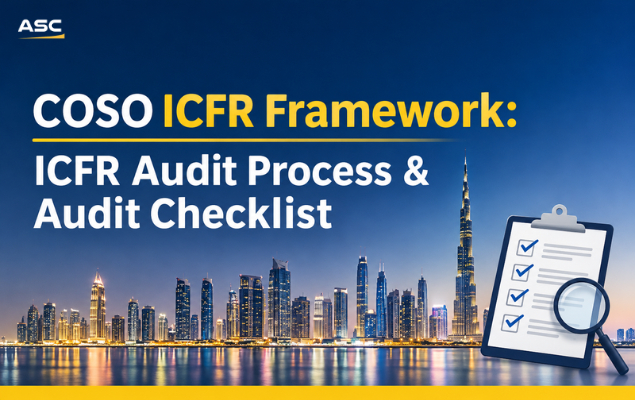
Internal Controls over Financial Reporting (ICOFR) is becoming an important compliance requirement for companies listed on the Abu Dhabi Securities Exchange (ADX) and Dubai Financial Market (DFM).
The Capital Market Authority (CMA), formerly the Securities and Commodities Authority (SCA), is responsible for overseeing the applicable capital market regulatory requirements. The transition from SCA to CMA took effect on 1 January 2026 under Federal Decree-Law No. 32 of 2025.
Under the phased ICOFR implementation requirements, companies are expected to assess the effectiveness of their financial reporting controls and obtain an independent external auditor's opinion. Mandatory public disclosure begins with the FY2027 reporting cycle.
With the 2026 trial phase approaching completion, listed companies should review their existing control arrangements and address any gaps that could affect their readiness for the mandatory reporting period.
Who Is Required to Comply with ICOFR in the UAE?
The CMA's ICOFR requirements principally apply to UAE-listed public joint-stock companies, including their material subsidiaries where applicable.
Certain categories, including foreign listed companies, private joint-stock companies and free zone entities listed on UAE markets, are outside the mandatory application scope under the relevant ICOFR circular.
Temporary exclusions may also be available for certain newly established, newly acquired or newly listed entities and foreign subsidiaries. Such exclusions are subject to the conditions and disclosure requirements prescribed in the applicable regulatory framework and should not be treated as automatic exemptions.
What About Banks and Insurance Companies?
Banks and insurance companies regulated by the CBUAE are subject to separate regulatory requirements concerning internal controls, governance, risk management and financial reporting.
For example:
- Banks must maintain effective internal control, compliance and internal audit functions under the CBUAE's Internal Controls, Compliance and Internal Audit Regulation.
- Insurance companies must comply with the CBUAE's Risk Management and Internal Controls Regulation and the associated standards.
- Banks and insurance companies listed on UAE capital markets must assess their CMA-related obligations alongside applicable CBUAE requirements.
The 2027 ICOFR reporting timeline should therefore not be treated as a universal deadline for all CBUAE-regulated institutions. Applicability depends on the entity's regulatory status and relevant reporting obligations.
What Changes Between 2026 and 2028?
The former SCA (now CMA) extended the first phase of ICOFR implementation through a circular issued in November 2025. This extension provides listed companies with additional time to assess their internal controls before mandatory public reporting begins.
The revised implementation timeline is as follows:
FY2025 – Preparatory Period
Companies could undertake voluntary ICOFR assessments and strengthen their internal control arrangements ahead of the formal reporting requirements.
FY2026 – Trial Phase
Companies are expected to conduct an internal evaluation of their controls, prepare an internal assessment report and obtain an external auditor's opinion on control effectiveness. Public disclosure of the report and opinion is not required during this phase.
FY2027 – Mandatory Reporting
From 1 January 2027, the mandatory phase begins. Companies must undertake an internal control assessment and disclose the relevant report, including the external auditor's opinion, within their integrated annual report for FY2027, before the General Assembly meeting.
FY2028 – Risk Management Reporting
From 2028, the reporting scope expands to include risk management, in addition to the internal control requirements.
The Committee of Sponsoring Organizations of the Treadway Commission (COSO) framework provides a recognised basis for evaluating internal controls. External assurance may be performed using ISAE 3000, subject to the applicable regulatory requirements and assurance engagement.
The Board of Directors retains overall responsibility for ensuring adequate internal controls and appropriate oversight of identified deficiencies.
Five Steps to Prepare for ICOFR Compliance
Companies should approach ICOFR readiness as a structured assessment of their existing financial reporting processes rather than simply a documentation exercise.
1. Identify Key Financial Reporting Areas
Begin by identifying material financial statement balances, significant transactions, relevant business processes and the IT systems supporting financial reporting.
Areas such as revenue recognition, procurement, payroll, fixed assets, treasury and financial closing should be considered based on their financial significance and associated risks.
2. Prepare or Review the Risk and Control Matrix (RCM)
Document the financial reporting risks and the controls established to address them.
Each control should have a clearly identified owner, defined frequency and supporting evidence. For example, monthly bank reconciliations should be prepared, reviewed and approved, with records retained for verification.
3. Assess Control Design
Evaluate whether the existing controls are suitably designed to prevent or detect material errors in financial reporting.
For example, a company may have a journal-entry approval process, but the control may be inadequate if the same individual can prepare and approve material entries without independent review.
4. Test Operating Effectiveness
Review whether controls have operated consistently during the relevant assessment period.
Testing may include examining reconciliations, journal approvals, management reviews, supporting records and user access permissions.
Where controls are performed manually, sufficient evidence should be maintained to demonstrate their execution.
5. Address Gaps and Obtain Management Sign-Off
Identified deficiencies should be documented, assigned to responsible process owners and addressed within agreed timelines.
Following corrective action, companies should retest the affected controls and document the results.
Management can then use the assessment findings to support its conclusion on the effectiveness of internal controls.
What Does an ICOFR Readiness Assessment Include?
An ICOFR readiness assessment helps companies understand whether their existing controls and supporting documentation are sufficient for the upcoming reporting requirements.
A typical assessment covers:
- Identification of material financial reporting risks and significant processes.
- Review of the existing Risk and Control Matrix (RCM).
- Evaluation of control design and operating effectiveness.
- Assessment of relevant IT General Controls (ITGC), including user access and system changes.
- Identification and classification of control deficiencies.
- Preparation of a practical remediation plan with responsibilities and timelines.
- Documentation of testing results and supporting evidence for management review.
The assessment also helps companies identify areas requiring attention before the external auditor conducts an independent review.
Common ICOFR Gaps Found During Assessments
Even companies with established finance and internal audit teams may face challenges in demonstrating control effectiveness.
Some commonly observed gaps include:
Incomplete review evidence: Reconciliations and journal entries are reviewed, but approvals are not consistently documented.
Inadequate segregation of duties: Employees have conflicting responsibilities in transaction processing and approval.
Limited IT control coverage: User access reviews, system changes and privileged access controls are not adequately assessed.
Manual financial reporting: Critical calculations depend on spreadsheets without independent checks.
Third-party dependencies: Outsourced financial processes are not supported by sufficient control assurance.
Unresolved deficiencies: Control weaknesses are identified but corrective actions and retesting are not properly documented.
Addressing these areas during the trial phase can reduce the risk of significant findings during mandatory ICOFR reporting.
Why Should UAE-Listed Companies Act Before the End of 2026?
The 2026 trial phase provides an opportunity to assess existing controls and address weaknesses before the mandatory reporting requirements take effect.
Companies that begin their assessments only in 2027 may find it difficult to establish sufficient evidence of operating effectiveness, particularly for controls performed quarterly, semi-annually or annually.
Early preparation also allows finance, internal audit, risk management and IT teams to agree on control responsibilities and maintain consistent documentation.
For companies with multiple subsidiaries or complex reporting systems, additional time may be required to complete scoping, testing and remediation across the organisation.
Frequently Asked Questions (FAQs)
Is ICOFR mandatory for all companies in the UAE?
No. The CMA's mandatory ICOFR reporting requirements principally apply to UAE-listed public joint-stock companies falling within the scope of the relevant circular. Private companies and other entities may be subject to separate internal control requirements based on their applicable regulatory framework.
What must listed companies complete during the 2026 ICOFR trial phase?
Companies should evaluate their internal controls, prepare an internal assessment report and obtain an external auditor's opinion for the 2026 financial year. The report and auditor's opinion are not required to be publicly disclosed during the trial phase.
Does the 2027 ICOFR deadline apply to banks and insurance companies?
The CMA's 2027 ICOFR timeline is relevant to entities falling within its reporting scope, including applicable listed financial institutions. CBUAE-regulated banks and insurers must also comply with their respective internal control requirements, irrespective of the CMA reporting timeline.
Which framework should companies use for ICOFR assessment?
COSO is a widely recognised framework for evaluating internal controls over financial reporting. Companies should apply the relevant regulatory criteria and agree on the appropriate assurance approach with their external auditors, including the use of ISAE 3000 where applicable.
Is external auditor involvement mandatory under the ICOFR requirements?
Yes, the phased requirements provide for an external auditor's opinion on internal control effectiveness. During the 2026 trial phase, the opinion is not publicly disclosed. For FY2027, the relevant report and opinion must be disclosed as prescribed by the applicable reporting requirements.
Can existing internal audit work be used for ICOFR compliance?
Existing internal audit reports, process documentation and control testing results can support an ICOFR assessment. However, companies should evaluate whether the work provides sufficient coverage and evidence for the applicable ICOFR requirements. Internal audit work does not replace the required independent external auditor's opinion.
What happens if control weaknesses are identified?
Management should assess the significance of each deficiency, identify the cause, implement corrective measures and retest the affected controls. Significant or unresolved deficiencies should be appropriately reflected in the assessment and related reporting, based on the applicable criteria.
How ASC Global UAE Can Help with ICOFR Readiness
Is Your Company Prepared for the 2027 ICOFR Reporting Requirements?
For UAE-listed companies, ICOFR readiness is not just about having financial controls in place. It is also about demonstrating that those controls work consistently and that sufficient evidence is available for independent assessment.
ASC Global UAE supports organisations with internal control assessments, Risk and Control Matrix development, design and operating effectiveness testing, IT General Controls reviews and remediation planning.
Our approach focuses on identifying practical control gaps, improving documentation and helping management prepare for the applicable ICOFR reporting requirements.
If your company has not yet completed its ICOFR readiness assessment, now is the time to identify potential gaps before they affect the 2027 reporting cycle.
Connect with ASC Global UAE to discuss your ICOFR readiness requirements and the areas that may need attention before mandatory reporting begins.
Email: info@ascglobal.ae
Call: +971 54 390 7670
 Risk Advisory

 Tech & Cyber Security
 Merger & Acquisition
 Due Diligence
 Business Advisory
 Business Setup & PRO
 Corporate Tax Advisory
 Accounting & Assurance
 VAT Advisory