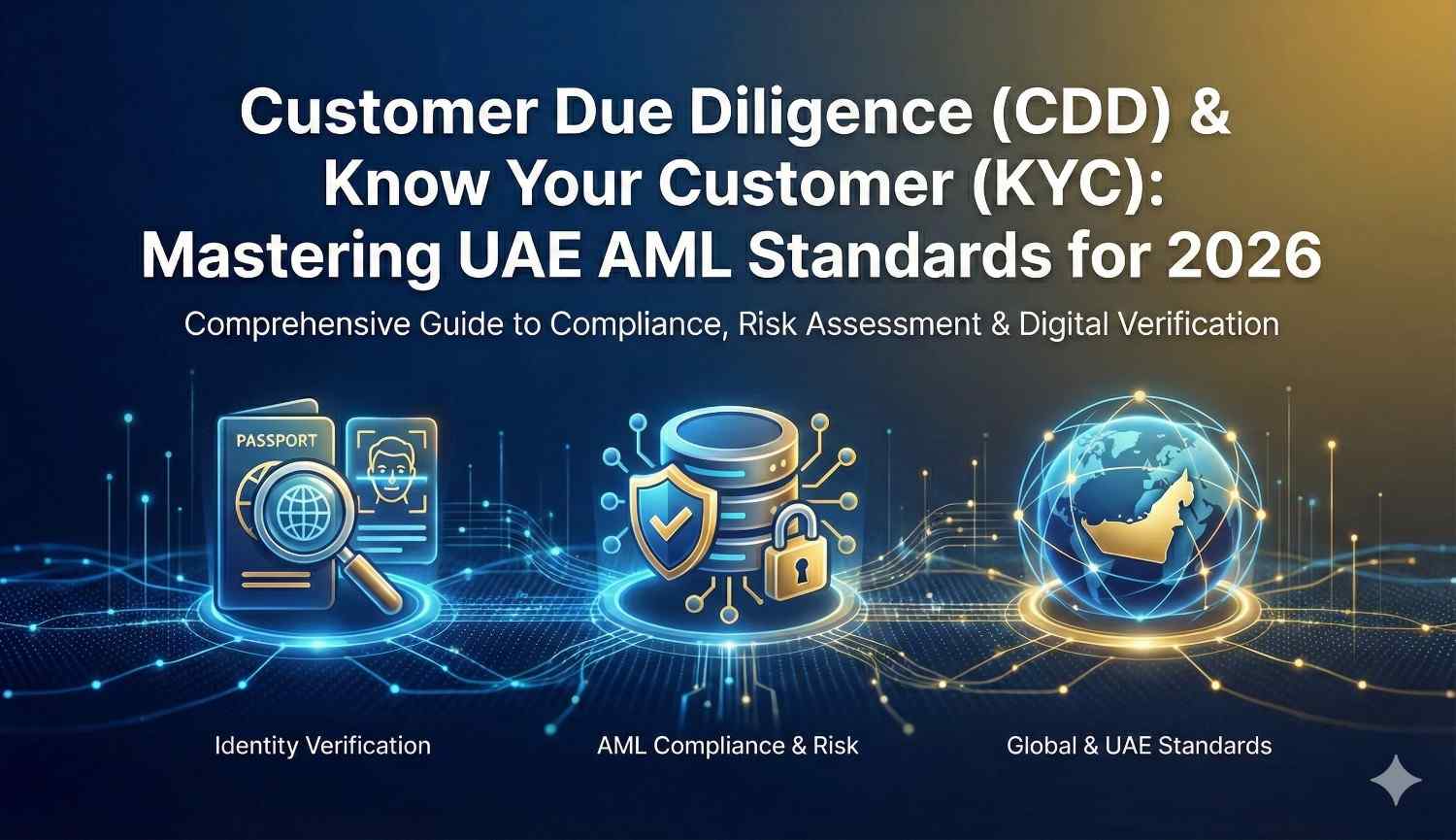
The UAE's AML regime demands inspection-ready CDD/KYC frameworks under Federal Decree-Law No. 10/2025. Financial institutions, fintechs, real estate, accounting firms, and ALL DNFBPs face intensified FIU scrutiny on beneficial ownership verification, enhanced due diligence, and comprehensive AML documentation. Non-compliance = license suspension, AED 5M+ fines, reputational destruction.
The UAE’s AML architecture rests on Federal Decree-Law No. 20 of 2018, Cabinet Decision No. 10 of 2019, and newly enforced Federal Decree-Law No. 10 of 2025. These laws mandate risk-based customer due diligence UAE as the foundational control against money laundering. Regulators in 2025 expect documented risk assessments, AML documentation proving verification, and governance trails demonstrating senior management oversight.
Customer due diligence UAE is systematic identification, verification, risk assessment, and beneficial ownership verification of customers. It sits at the core of AML compliance UAE, enabling detection of suspicious activity.
The UAE applies three CDD levels:
Simplified Due Diligence (SDD) applies to low-risk customers: government entities, regulated financial institutions, listed companies. Documentation is lighter but risk justification must be documented.
Standard CDD covers typical customers. Standard KYC requirements UAE include identity verification through reliable documents, understanding business purpose, assessing customer risk, and screening for sanctions/PEPs.
Enhanced Due Diligence (EDD) applies to high-risk customers: PEPs, high-risk jurisdictions, complex ownership, cash-intensive businesses, suspicious patterns. Enhanced due diligence UAE adds source-of-funds verification, senior management approval, and heightened transaction monitoring.
Step 1: Customer Identification - Collect: legal name, business registration, beneficial owners (25%+ threshold), residential address, contact information. Document all shareholders meeting beneficial ownership UAE thresholds.
Step 2: Identity Verification - Use reliable independent documents: government ID, company certificates, director lists, beneficial ownership registers. Never rely on unverified documents.
Step 3: Risk Classification - Assign ratings (Low/Medium/High) based on profile, transaction patterns, industry, geography, and ownership structure. High-risk triggers EDD; medium-risk warrants standard CDD; low-risk qualifies for SDD.
Step 4: Ongoing Monitoring - Establish monitoring aligned with risk: high-risk monthly reviews, medium-risk quarterly, low-risk annually. Flag unusual transactions against expected behavior; escalate suspicious activity to SAR filing.
The UAE’s beneficial ownership rules mandate identifying Ultimate Beneficial Owners (UBOs)—natural persons controlling 25%+ of an entity, regardless of corporate layering. This is central to customer due diligence UAE because no framework is complete without understanding true beneficial owners.
Entities must maintain Beneficial Ownership Registers documenting UBO identity, ownership percentage, and control mechanisms. Updates must occur within specified timelines when ownership changes. For complex structures spanning jurisdictions, tracing ownership chains to identify natural persons requires specialized expertise.
AML documentation related to beneficial ownership (registers, verification records, updates, escalation trails) must be maintained five years minimum and made available to regulators during inspections.
Enhanced due diligence UAE is mandatory for high-risk customers. Beyond standard KYC, EDD requires:
Common EDD scenarios: government officials and family (PEPs), customers in FATF-listed jurisdictions, shell companies lacking business purpose, cash real estate transactions, precious metals dealers, customers with adverse media mentions.
Ongoing monitoring isn’t static. Periodic KYC refresh (annual minimum), reassess risk as circumstances change, escalate to SAR when suspicious activity emerges.
Regulators expect comprehensive AML documentation proving compliance:
Technology tools supporting customer due diligence UAE are critical:
Prioritize tools generating comprehensive audit trails, aligned with UAE data retention requirements, integrated with existing systems.
ASC-Global UAE specializes in translating regulatory requirements into operational advantage:
CDD/KYC Framework Design: Risk-based policies tailored to business model, customer base, regulatory expectations. Cover SDD, standard CDD, EDD triggers with clear documentation.
Policy Implementation: Onboarding workflows, risk classification matrices, KYC requirements UAE checklists, beneficial ownership procedures. Ensure staff understand when EDD applies.
AML Documentation Audit: Review CDD/KYC files, beneficial ownership records, AML documentation for completeness and inspection readiness. Develop remediation roadmaps.
Technology Advisory: Assist selecting, configuring, integrating KYC platforms, screening tools, UBO solutions aligned with UAE standards.
Staff Training & Audits: Conduct targeted training and CDD/KYC audits identifying gaps before regulatory inspections.
Q: What is customer due diligence UAE and why is it critical?
A: Customer due diligence UAE is systematic customer identification, verification, and risk assessment. It’s critical because it prevents money laundering by ensuring organizations understand who they do business with, enabling suspicious activity detection.
Q: When must businesses perform enhanced due diligence?
A: Enhanced due diligence UAE is mandatory for high-risk customers: PEPs, high-risk jurisdictions, complex structures, cash-intensive businesses, suspicious patterns. Triggers include high-value transactions, politically exposed relationships, adverse media.
Q: What AML documentation proves CDD/KYC compliance?
A: Maintain AML documentation including identification/verification files, risk assessments, beneficial ownership registers, EDD memos with approvals, monitoring logs, policies, staff training records, transaction monitoring reports. Retain minimum five years.
Q: How often should KYC information be updated?
A: KYC requirements UAE mandate periodic refresh by risk: high-risk quarterly, medium-risk annually, low-risk every two years. Update when circumstances change or suspicious activity surfaces.
Q: How do beneficial ownership UAE rules link to CDD?
A: Beneficial ownership UAE identification is integral to customer due diligence UAE. No CDD is complete without identifying true beneficial owners. Identify UBOs (25%+), verify identity, maintain Registers documenting ownership chains.
Q: How can ASC-Global UAE help establish CDD/KYC processes?
A: ASC designs risk-based frameworks, implements policies/procedures, conducts audits, advises on technology, trains staff, and ensures AML documentation meets inspection standards. End-to-end support from design through governance.
The 2025 regulatory environment demands documented, risk-based customer due diligence UAE integrated with beneficial ownership verification, enhanced due diligence protocols, and comprehensive AML documentation. Organizations with outdated frameworks face severe penalties, license suspension, and reputational damage.
Strong CDD/KYC systems streamline onboarding, enhance customer intelligence, and demonstrate regulatory commitment during inspections.
To assess whether your CDD/KYC framework meets 2025 UAE AML expectations, contact ASC-Global UAE:
📞 Call: +971503287722
💬 WhatsApp: https://wa.me/971503287722
🌐 Visit: www.ascglobal.ae
📩 Email: info@ascglobal.ae
Office 04-1803, 18th Floor | One by Omniyat, Business Bay, Dubai
Discover how we’ve helped 150+ UAE entities implement inspection-ready CDD/KYC frameworks—streamlining onboarding, reducing compliance risk, and ensuring regulatory confidence.
Your customers deserve due diligence built on expertise. Your regulators deserve documentation built on rigor. Let ASC-Global UAE deliver both.
Need more information on Customer Due Diligence (CDD) & Know Your Customer (KYC): Mastering UAE AML Standards for 2025?
 Risk Advisory
Dubai's Golden Visa programme has drawn a genuinely global pool of property investors, offering long-term residency in e...
Read More
Office 04 - 1803, 18th floor, One by Omniyat Business bay, Dubai
302-18 Edgecliff Golfway, North York, Toronto, Ontario M3C 3A3
Via F.lli Gabba 3, 20121 – Milan, Italy
RM2106, Huishangsha Edifice, No.37, Baoshi West RD, Shiyan Town, Bao’an District, Shenzhen - 518108, China
C-100, Sector 2, Noida (UP), Delhi NCR, India 201301
One Raffles Place, Tower 1, 27-03 Singapore - 048616
 Merger & Acquisition
 Due Diligence
 Business Advisory
 Business Setup & PRO
 Corporate Tax Advisory
 Accounting & Assurance
 Risk Advisory
 Tech & Cyber Security
 VAT Advisory