In the UAE’s evolving regulatory climate, Anti-Money Laundering (AML) compliance is no longer a formality. It is a board-level responsibility.
Regulators are conducting more inspections. Reporting requirements are stricter. Penalties are heavier. And most importantly, enforcement is no longer limited to financial institutions.
Today, real estate brokers, corporate service providers, accounting firms, dealers in precious metals and stones (DPMS), and various Designated Non-Financial Businesses and Professions (DNFBPs) fall squarely under scrutiny.
Yet many businesses believe they are compliant simply because they have an AML policy document on file.
That assumption is dangerous.
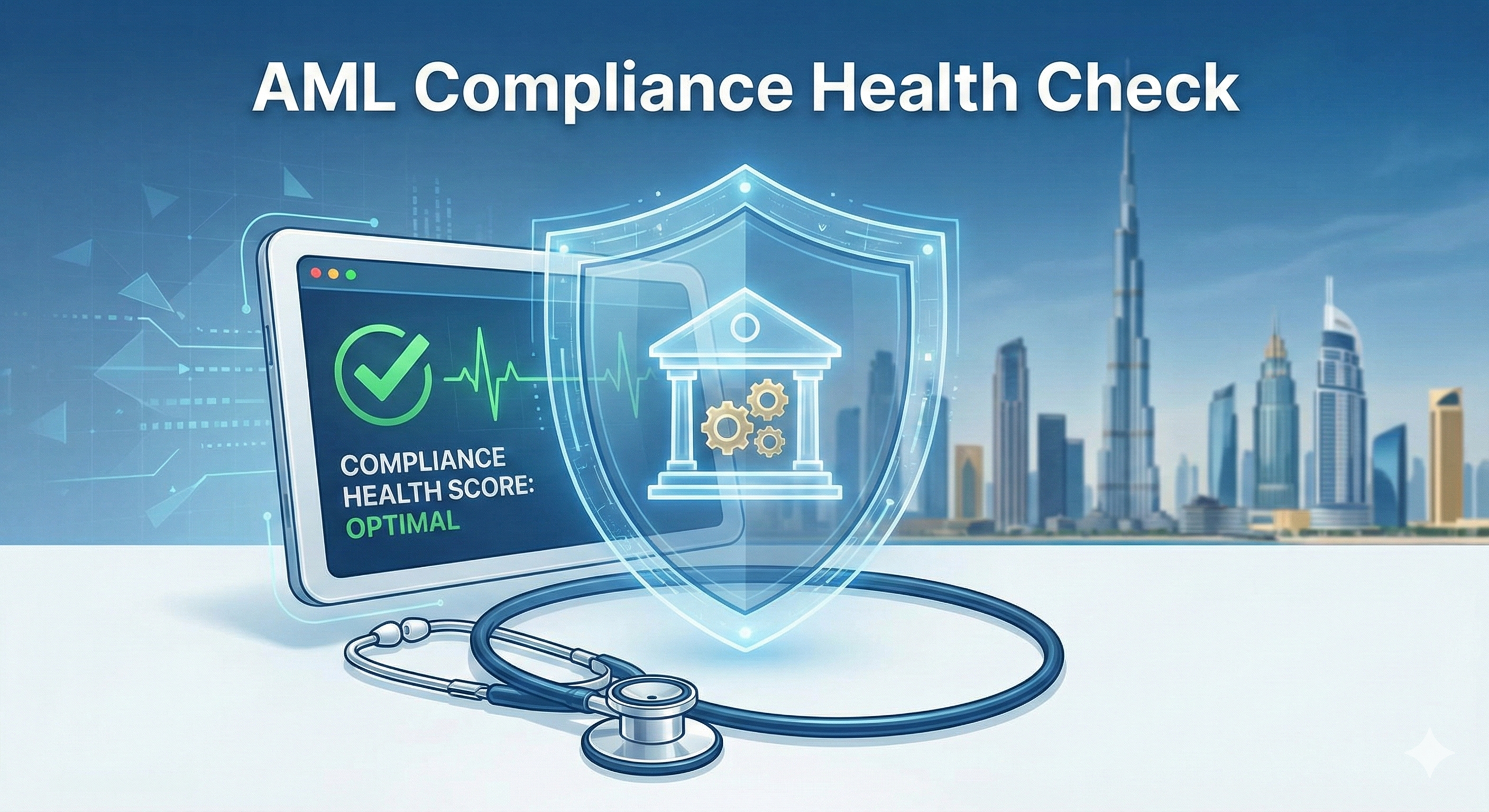
An AML Compliance Health Check evaluates whether your framework works in practice — not just on paper. It identifies exposure before regulators do.
The UAE has strengthened its AML regime in recent years to align with international standards and FATF expectations. In the first half of 2025 alone, inspections on DNFBPs resulted in 1,063 violations and more than AED 42 million in AML fines, with real estate brokerages, precious metals traders, and corporate service providers most affected. As a result:
More importantly, regulators are assessing substance over form.
It’s no longer enough to say:
“We have a policy.”
“We appointed an AML compliance officer.”
“We conducted one training session.”
Authorities now ask:
That’s where an AML health check becomes critical.
These questions are designed to test whether your AML controls operate in practice, not just exist in manuals or policy binders.
An AML Compliance Health Check is a structured diagnostic review of your existing AML framework, measuring both technical alignment with UAE legislation and supervisory guidelines, and the actual implementation of those controls day‑to‑day.
Think of it as a regulatory stress test.
Instead of waiting for an inspection notice, you proactively test your systems to identify weaknesses.
It typically evaluates:
The objective is simple: close compliance gaps before they become violations.
After working with mainland and free zone entities across sectors, certain recurring gaps appear.
Many companies completed an initial AML risk assessment when regulations were introduced — and never updated it. Risk profiles evolve. If your assessment hasn’t been reviewed in 12 months, it may already be insufficient. Regulators now expect business-wide AML risk assessments to be updated at least annually or whenever there is a material change in products, customers, or geography.
Collecting Emirates ID copies is not enough. Proper CDD requires risk classification, verification of beneficial ownership, and documented source of funds analysis for higher-risk clients.
Employees often don’t know:
Without a documented reporting chain, compliance collapses at the operational level.
AML is not a one-time onboarding exercise. Many businesses fail to conduct periodic reviews of high-risk clients or transactions.
Generic annual AML training may not address the specific risks of your industry. Regulators expect tailored awareness programs aligned with your business model.
A mid-sized real estate brokerage believed it was compliant because it had registered on the goAML portal and appointed a compliance officer.
During an inspection, regulators found:
The result? Administrative fines and mandatory corrective action.
The company had a policy — but not a functioning AML framework.
This situation is avoidable.
Regulatory expectations are intensifying. Authorities now focus on:
These expectations are reinforced by the UAE’s 2024–2027 National AML/CFT Strategy and its commitment to maintaining strong FATF-aligned enforcement after Grey List removal.
Businesses operating in high-risk sectors face even closer supervision.
In this environment, reactive compliance is risky. Proactive health checks provide clarity and control.
An effective AML framework in the UAE should clearly show:
If any of these elements are unclear or undocumented, your exposure increases.
An independent compliance review provides:
It shifts your business from uncertainty to structured compliance.
More importantly, it protects your reputation. AML breaches are not just financial risks — they can damage credibility with banks, partners, and regulators.
Ask yourself:
If any answer feels uncertain, a professional review is advisable.
What is an AML Compliance Health Check?
An AML Compliance Health Check is a structured review of your existing AML policies, procedures, and controls to ensure alignment with UAE regulations and regulatory expectations. It identifies gaps before inspections or penalties occur.
Who needs AML compliance in the UAE?
Financial institutions and DNFBPs such as real estate brokers, corporate service providers, accountants, auditors, and dealers in precious metals and stones are legally required to implement AML frameworks under UAE law and related Cabinet Decisions.
How often should AML frameworks be reviewed?
Best practice in the UAE recommends reviewing and updating AML risk assessments and internal controls at least annually or whenever significant changes occur in business activity or regulatory requirements.
If you are uncertain whether your AML framework would withstand a regulatory inspection in 2026, now is the time to review it — not after receiving a notice.
To assess whether your AML policies, risk assessment, CDD procedures, STR reporting systems, and internal controls meet current UAE regulatory expectations, contact ASC-Global UAE:
📞 Call: +971503287722
💬 WhatsApp: https://wa.me/971503287722
🌐 Visit: www.ascglobal.ae
📩 Email: info@ascglobal.ae
📍 Office 04-1803, 18th Floor | One by Omniyat, Business Bay, Dubai
ASC-Global UAE has helped 150+ UAE entities strengthen their AML frameworks — identifying compliance gaps, improving documentation standards, aligning internal processes with supervisory authority expectations, and preparing businesses for inspection readiness.
An AML Health Check today can prevent regulatory disruption tomorrow.
Your business deserves proactive compliance.
Your regulators expect documented control.
Let ASC-Global UAE ensure you are fully aligned, inspection-ready, and protected.
Need more information on Anti-Money Laundering Compliance Health Check for UAE Businesses?
 Risk Advisory
Dubai's Golden Visa programme has drawn a genuinely global pool of property investors, offering long-term residency in e...
Read More
Office 04 - 1803, 18th floor, One by Omniyat Business bay, Dubai
302-18 Edgecliff Golfway, North York, Toronto, Ontario M3C 3A3
Via F.lli Gabba 3, 20121 – Milan, Italy
RM2106, Huishangsha Edifice, No.37, Baoshi West RD, Shiyan Town, Bao’an District, Shenzhen - 518108, China
C-100, Sector 2, Noida (UP), Delhi NCR, India 201301
One Raffles Place, Tower 1, 27-03 Singapore - 048616
 Merger & Acquisition
 Due Diligence
 Business Advisory
 Business Setup & PRO
 Corporate Tax Advisory
 Accounting & Assurance
 Risk Advisory
 Tech & Cyber Security
 VAT Advisory