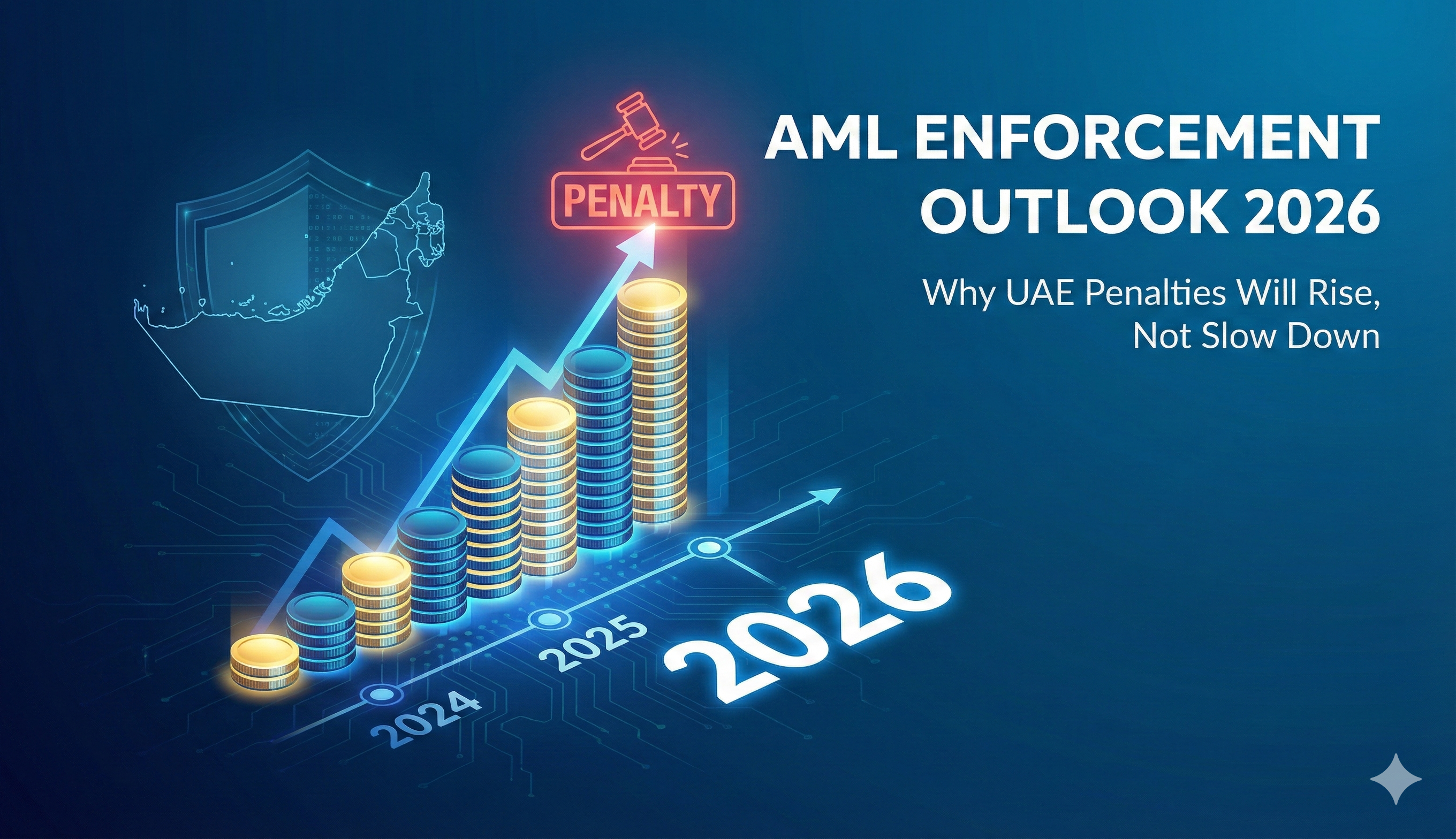
Over the past few years, the UAE has transformed its anti-money laundering (AML) framework from policy-driven compliance to enforcement-driven supervision. In 2026, that shift is accelerating. In just the first half of 2025, AML inspections on DNFBPs alone resulted in fines exceeding AED 42 million, with real estate brokerages, precious metals traders, and corporate service providers among the most penalised sectors.
Penalties are not rising because violations are new. They are rising because detection is sharper, monitoring is broader, and supervisory expectations are no longer negotiable.
For Designated Non-Financial Businesses and Professions (DNFBPs), real estate brokers, corporate service providers, and high-risk trading entities, the enforcement environment in 2026 is materially stricter than even two years ago.
Earlier phases of AML regulation in the UAE focused heavily on awareness, onboarding, and corrective guidance. That phase has ended.
Supervisory authorities now operate under:
Administrative fines in 2026 are increasingly linked to procedural and governance failures—such as weak CDD, late STRs, and poor record-keeping—not just confirmed money laundering activity.
This includes:
Enforcement has become structural, not reactive.
Regulatory bodies now share data more efficiently. Corporate registries, licensing authorities, and AML supervisory units operate with greater visibility over business activities.
Inconsistencies between declared business models and actual transactions are easier to identify.
Authorities are not inspecting randomly. High-risk sectors such as:
are being prioritized through algorithmic risk indicators and transaction analysis.
A significant number of AML penalties stem not from criminal conduct but from:
In 2026, documentation integrity equals compliance credibility.
Global regulatory expectations continue to influence domestic enforcement intensity. Following the UAE’s removal from the FATF Grey List, authorities have maintained a strong enforcement posture to demonstrate sustained effectiveness ahead of future assessments.
The direction is clear: enforcement will not slow.
DNFBPs supervised by the Ministry of Economy and Tourism—especially real estate brokers, precious metals and gemstone dealers, auditors, and corporate service providers—have already seen a sharp rise in inspections and penalties.
Common vulnerability patterns include:
Many penalties arise because AML programs exist on paper — not in practice.
Based on enforcement trends, supervisory reviews increasingly assess:
Authorities are looking for evidence of operational integration — not template compliance.
Businesses that want to remain penalty-resilient must move beyond minimal compliance.
A strong AML governance structure in 2026 should include:
Policies must reflect actual geographic exposure, client profile, and transaction patterns.
CDD updates and ongoing review cannot remain static documents.
The appointed AML officer must have reporting authority and operational independence.
External AML audits strengthen defensibility during inspections.
Compliance maturity now differentiates stable businesses from exposed ones.
AML compliance in 2026 is not a regulatory checkbox — it is a governance benchmark.
The UAE’s enforcement trajectory indicates sustained scrutiny, particularly for businesses operating in high-risk sectors or handling cross-border transactions.
Organizations that proactively strengthen their AML framework will not only reduce penalty exposure but also enhance credibility with regulators, financial institutions, and investors.
The question is no longer whether inspections will happen — but whether your compliance framework can withstand them.
Q1. Why are AML penalties increasing in the UAE in 2026?
A1. Penalties are rising due to stronger enforcement mechanisms, smarter risk-based inspections, and increased documentation scrutiny, even where no underlying money laundering offence is proven.
Q2. Which businesses are most at risk of AML fines?
A2. Real estate firms, precious metals traders, corporate service providers, auditors, and high-risk trading entities face higher inspection frequency and larger aggregate fine volumes.
Q3. How can companies reduce AML penalty exposure?
A3. By maintaining updated risk assessments, ensuring proper CDD documentation, conducting staff training, and performing independent AML reviews.
If your AML framework has not undergone a structured review in the past 12 months, your business may be exposed to regulatory risk.
ASC Global provides comprehensive AML risk assessments, policy reviews, compliance audits, and advisory support tailored to UAE regulatory expectations.
Strengthen your compliance framework before enforcement reviews begin.
📧 info@ascglobal.ae
📞 Call: +971503287722
💬 WhatsApp: https://wa.me/971503287722
🌐 ascglobal.ae/our-services
Need more information on AML Enforcement Outlook 2026: Why UAE Penalties Will Rise, Not Slow Down?
 Risk Advisory
Dubai's Golden Visa programme has drawn a genuinely global pool of property investors, offering long-term residency in e...
Read More
Office 04 - 1803, 18th floor, One by Omniyat Business bay, Dubai
302-18 Edgecliff Golfway, North York, Toronto, Ontario M3C 3A3
Via F.lli Gabba 3, 20121 – Milan, Italy
RM2106, Huishangsha Edifice, No.37, Baoshi West RD, Shiyan Town, Bao’an District, Shenzhen - 518108, China
C-100, Sector 2, Noida (UP), Delhi NCR, India 201301
One Raffles Place, Tower 1, 27-03 Singapore - 048616
 Merger & Acquisition
 Due Diligence
 Business Advisory
 Business Setup & PRO
 Corporate Tax Advisory
 Accounting & Assurance
 Risk Advisory
 Tech & Cyber Security
 VAT Advisory