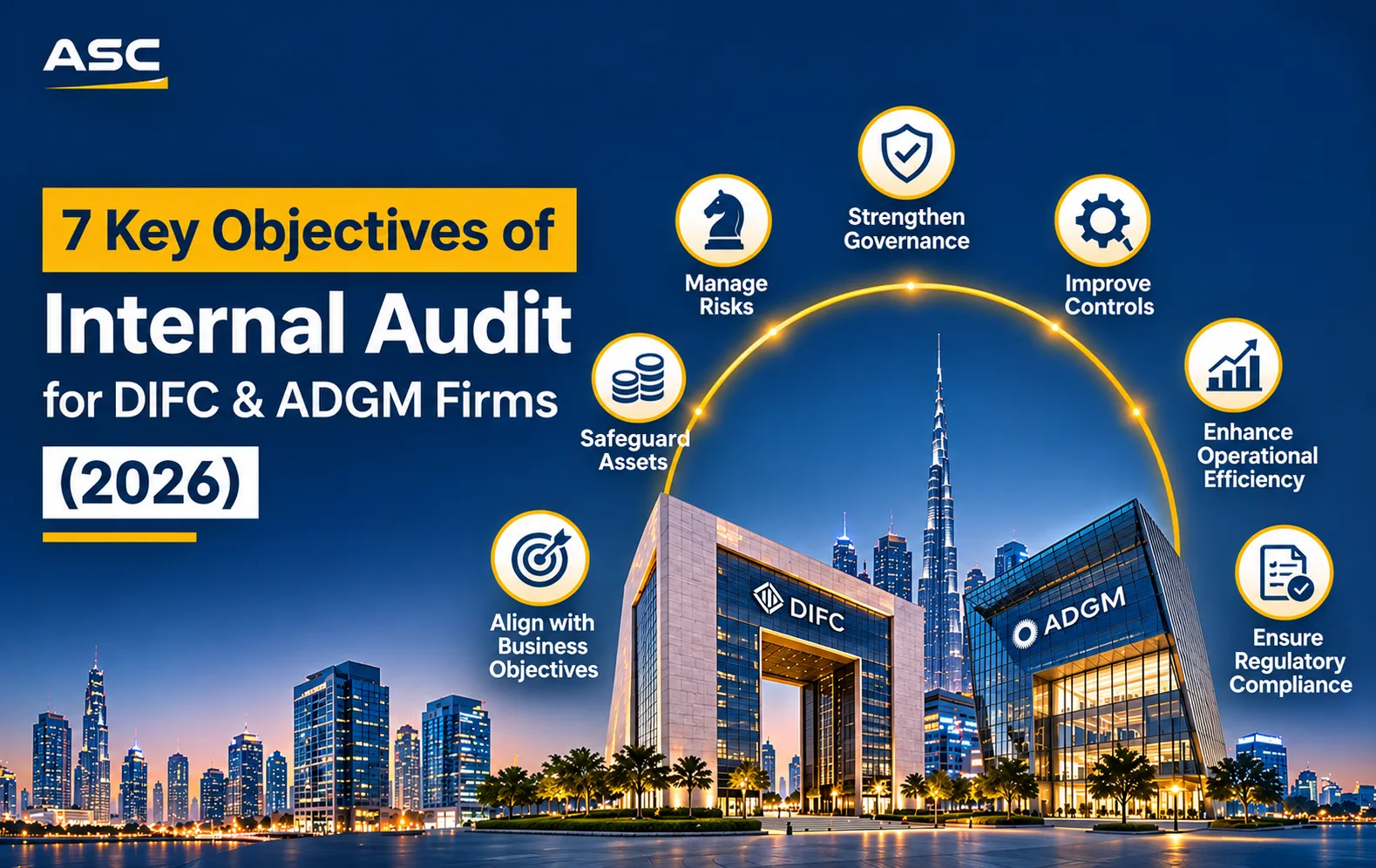
Ask ten managers what internal audit is for, and you may hear ten different answers: checking compliance, detecting errors or preparing for an external audit. While these are relevant, the purpose of internal audit goes much further.
The Global Internal Audit Standards, effective from 9 January 2025, emphasise the role of independent assurance, advice, insight and foresight in helping organisations create and preserve long-term value.
For financial services firms operating in the Dubai International Financial Centre (DIFC) and Abu Dhabi Global Market (ADGM), internal audit plays an important role in strengthening governance, assessing regulatory compliance, protecting client interests and supporting effective management oversight.
Understanding the key objectives of internal audit can help firms develop an audit approach aligned with their business risks and applicable DFSA or FSRA requirements.
What Are the Seven Key Objectives of Internal Audit?
1. Evaluate the Effectiveness of Internal Controls
Assess whether internal controls are appropriately designed and operating effectively. For DIFC and ADGM firms, this may include reviewing transaction approvals, financial reconciliations, segregation of duties, system access controls and delegated authority.
2. Assess Risk Management and Governance
Evaluate how effectively the organisation identifies, assesses, monitors and manages its financial, operational, strategic and regulatory risks.
Risk-based internal audit prioritises areas with significant risk exposure while assessing governance arrangements, risk reporting and the effectiveness of management oversight.
3. Strengthen Regulatory and Internal Compliance
Assess adherence to applicable DFSA or FSRA requirements, internal policies and Standard Operating Procedures (SOPs).
Depending on the firm's regulated activities, audit coverage may include AML/KYC controls, regulatory reporting, client classification, suitability assessments and compliance monitoring arrangements.
4. Safeguard Assets and Mitigate Fraud Risks
Identify weaknesses that could expose company or client assets, funds and sensitive information to fraud, misuse or unauthorised access.
Relevant audit areas may include client money arrangements, custody controls, conflicts of interest, unauthorised transactions and information security.
5. Improve Operational Efficiency and Business Performance
Identify process bottlenecks, unnecessary costs, duplication of activities and operational weaknesses.
For financial services firms, this may involve reviewing client onboarding, transaction processing, outsourced activities and third-party service provider oversight to identify opportunities for improvement.
6. Support Reliable Financial and Regulatory Reporting
Evaluate controls supporting the accuracy, completeness and reliability of financial statements, prudential returns, regulatory submissions and management information.
This may include assessing Internal Controls over Financial Reporting (ICFR) as part of the approved internal audit scope. However, management remains responsible for establishing and maintaining these controls.
7. Monitor Corrective Actions and Strengthen Accountability
Follow up on audit findings to assess whether agreed corrective actions have been implemented effectively.
Unresolved regulatory observations, recurring control weaknesses and overdue management action plans should be escalated to the appropriate management or Governing Body.
How Does Internal Audit Differ from External Audit?
Both functions contribute to organisational accountability but serve different purposes.
|
Parameter
|
Internal Audit
|
External Audit
|
|
Primary Objective
|
Assess governance, risks and controls
|
Express an opinion on financial statements
|
|
Scope
|
Financial, operational, regulatory, IT and governance processes
|
Primarily financial reporting
|
|
Reporting
|
Governing Body or Audit Committee and management
|
Shareholders or other intended users
|
|
Frequency
|
Based on the approved risk-based audit plan
|
Generally annual
|
|
Focus
|
Independent assurance, risk identification and business improvement
|
Financial statement assurance
|
The two functions complement each other, but neither replaces the other.
Internal Audit Requirements in DIFC and ADGM
Regulated financial services firms operating in DIFC and ADGM are subject to the requirements of the Dubai Financial Services Authority (DFSA) and the Financial Services Regulatory Authority (FSRA), respectively.
Both regulators establish requirements concerning the independence, responsibilities and functioning of internal audit.
|
Regulatory Requirement
|
DIFC – DFSA
|
ADGM – FSRA
|
|
Establishment of an independent internal audit function to evaluate systems and controls
|
GEN 5.3.13
|
GEN 3.3.13
|
|
Access to relevant records without restriction and access to the Governing Body or its relevant committee when required
|
GEN 5.3.14
|
GEN 3.3.14
|
|
Documentation of internal audit structure, responsibilities and procedures
|
GEN 5.3.15
|
GEN 3.3.15
|
Internal audit requirements do not automatically apply to every company incorporated in DIFC or ADGM. Applicability depends on the firm's regulatory status, authorised activities and relevant exemptions or waivers.
For example, DFSA GEN 5.3.13(3) provides an exemption for Authorised Firms whose only Financial Service is Managing a Venture Capital Fund. The FSRA framework also provides specific exemptions and application limits.
Firms considering outsourced or co-sourced internal audit arrangements must assess applicable outsourcing requirements, including service provider due diligence, oversight and regulatory notifications, where required. Outsourcing does not transfer the firm's regulatory accountability to the service provider.
For a detailed understanding of jurisdiction-specific requirements, explore our dedicated guides:
What Should Internal Audit Cover in DIFC and ADGM Firms?
The internal audit scope should reflect the firm's authorised activities, operating model, regulatory obligations and risk exposure.
Typical audit areas may include:
|
Audit Area
|
Key Areas of Assessment
|
|
Corporate Governance
|
Governing Body oversight, delegated authority and accountability
|
|
Risk Management
|
Risk identification, assessment, monitoring and reporting
|
|
AML and Regulatory Compliance
|
Customer due diligence, sanctions screening, compliance monitoring and regulatory reporting
|
|
Client Protection
|
Client classification, suitability, client money and custody arrangements
|
|
Financial and Prudential Controls
|
Capital adequacy, financial reporting and regulatory returns
|
|
IT and Cybersecurity
|
System access, information security and business continuity
|
|
Outsourcing and Third-Party Risk
|
Service provider assessment, contractual controls and ongoing oversight
|
These areas are illustrative and should be assessed based on the firm's specific activities and applicable regulatory requirements.
What Makes an Internal Audit Function Effective?
An effective internal audit function should deliver more than periodic reports. Management and the Governing Body should receive:
➤ Risk-based audit coverage aligned with critical business and regulatory risks.
➤ Independent assessment of control weaknesses and emerging risks.
➤ Clear findings highlighting root causes and potential business impact.
➤ Practical recommendations with defined responsibilities and timelines.
➤ Regular follow-up and validation of corrective actions.
The real value of internal audit lies in identifying and addressing control weaknesses before they result in significant financial, operational or regulatory consequences.
How ASC Global UAE Supports Internal Audit for DIFC and ADGM Firms
ASC Global UAE delivers risk-based internal audit services tailored to the regulatory obligations, licensed activities and operational risks of firms operating in DIFC and ADGM.
Our services cover:
- Risk-based internal audit planning and execution.
- DFSA and FSRA regulatory compliance assessments.
- Financial, operational and internal control audits.
- Review of AML, KYC and client protection controls, where applicable.
- Governance, risk management and outsourcing assessments.
- Governing Body and Audit Committee reporting.
- Remediation monitoring and audit finding closure validation.
- Outsourced and co-sourced internal audit support, where permitted.
Our approach draws on the IIA Global Internal Audit Standards and relevant internal control frameworks, including COSO, to deliver meaningful assurance and practical recommendations aligned with each firm's regulatory and business requirements.
Is Your DIFC or ADGM Firm Receiving the Right Level of Internal Audit Assurance?
When was the last time your internal audit function independently assessed your firm's critical regulatory, operational and financial controls? Can your Governing Body confidently demonstrate that identified weaknesses are being addressed effectively?
Whether you are establishing a new internal audit function, experiencing recurring audit findings or seeking independent assurance over critical business risks, ASC Global UAE can help you strengthen your audit coverage and governance framework.
Speak to Our Internal Audit Specialists for DIFC and ADGM Firms.
Frequently Asked Questions (FAQs)
What is the main objective of internal audit?
Internal audit provides independent, risk-based assurance and advice to strengthen governance, risk management, internal controls and organisational performance.
Is internal audit mandatory for DIFC and ADGM firms?
Internal audit is generally required for regulated firms falling within applicable DFSA and FSRA provisions, subject to specific exemptions and waivers. Incorporation in DIFC or ADGM alone does not automatically create this obligation.
Is an annual internal audit mandatory in DIFC and ADGM?
The core GEN internal audit provisions do not prescribe a universal annual audit frequency for every business process. Audit frequency should reflect the firm's risk exposure, business complexity and applicable regulatory requirements. Certain areas may be subject to separate mandatory review frequencies.
Can internal audit be outsourced in DIFC and ADGM?
Yes, where permitted. Firms must maintain appropriate independence, service provider oversight and compliance with applicable outsourcing and regulatory notification requirements.
Who should the internal audit function report to?
Internal audit should operate independently of operational and business functions, with appropriate functional accountability and access to the Governing Body or its relevant committee.
Can compliance monitoring replace internal audit?
No. Compliance monitoring and internal audit serve distinct purposes. Compliance monitoring does not automatically satisfy the independent internal audit requirements prescribed by the applicable regulator.
What is the difference between internal audit and ICFR testing?
Internal audit evaluates wider organisational risks, governance and controls, whereas ICFR testing specifically assesses controls supporting reliable financial reporting.
 Risk Advisory

 Tech & Cyber Security
 Merger & Acquisition
 Financial & M&A Due Diligence Consulting Services
 Business Advisory
 Business Setup & PRO
 Corporate Tax Advisory
 Accounting & Assurance
 VAT Advisory